Free Shipping on US orders over $15Free Shipping on US orders over $15Free Shipping on US orders over $15Free Shipping on US orders over $15Free Shipping on US orders over $15Free Shipping on US orders over $15Free Shipping on US orders over $15Free Shipping on US orders over $15Free Shipping on US orders over $15Free Shipping on US orders over $15Free Shipping on US orders over $15Free Shipping on US orders over $15
In Chinese medicine, facial acupressure is the self-care practice of pressing named points on the face and neck with the fingertip to move Qi and Blood locally and, through the channel connection, to influence the related organ. It is the pressing version of acupuncture: the same points, worked with the pad of a finger instead of a needle.
The points are on the face, but the reasoning is not local. A point below the eye is treated as part of the Stomach channel, a point at the inner eyebrow as the start of the Bladder channel, and a point between the brows as a meeting place of the governing vessel. Pressing one is understood to affect the line it sits on.
Nothing pierces the skin, so the risks are much smaller than with needling. The whole practice is five to eight minutes, needs no equipment, and is the easiest of the hands-on practices in this section to learn. That does not make it evidence: see the evidence section below.
How TCM explains it
The theory is the same one that underlies the rest of this section. The face is where several channels surface, and where Blood and Qi are said to show first. The Stomach channel (足阳明胃经) runs up the cheek to the eye and the forehead, the Bladder channel begins at the inner corner of the eye and crosses the head, the Gallbladder channel passes through the temple, and the governing vessel runs up the midline of the face.
Two kinds of point are used together. Local points are pressed where the problem shows: the brow, the eye area, the cheekbone, the jaw. Distal points are on the hand, leg or foot, and are pressed because the channel they belong to reaches the face. Hegu (LI-4) on the hand and Zusanli (ST-36) on the leg are the two most used in a facial routine; Hegu is classically avoided in pregnancy and is not pressed then.
The pattern decides the points and the pressure. A face that is dusky and fixed is read as Blood Stagnation, and the work is slow and light. A face that is tight across the brow and jaw is read as Liver Qi Stagnation, and the sequence spends longer on the outer brow and the jaw. A face that is puffy and oily is read as Damp-Heat, and every contact is kept light and brief. When the skin is fine and dry, the pattern is Blood Deficiency and the sequence is shorter, with more oil and less pressure. Where the pattern is being treated internally as well, the practitioner may prescribe a formula such as Xiao Yao San for a Liver pattern or Gui Pi Tang for a Spleen pattern, and the facial routine is used alongside it.
Which skin pictures it is used for
The table gives the pictures a practitioner would work with acupressure, the pattern each belongs to, and how the sequence changes. Where a picture is listed as unsuitable, the reason is given rather than a modified technique, because pressing over inflamed skin is not a safe version of anything.
What you see
TCM pattern
How the sequence is adapted
Dusky, fixed discolouration, a face that looks tired rather than thin
Fewer points, more oil, very light pressure, stop while the skin is comfortable
Active acne, a rosacea flare, eczema or a fresh bruise
Not suitable
No acupressure over the lesions or the flare
Before you start: who should not do this
Before you start: who should not do this
Read this before the steps.
Do not use facial acupressure if you have:
broken, cut, sunburnt or peeling skin, or an active cold sore;
active acne lesions, cysts or nodules on the area you would press;
a rosacea flare, or a flare of eczema, dermatitis or urticaria;
had fillers, botulinum toxin, a chemical peel, laser treatment or microneedling in the past two weeks, or until the practitioner who did it says the skin has settled;
a skin infection or a feverish illness;
a mole or lesion you have not had assessed. Press around it, not on it;
glaucoma, or recent eye surgery, before working the eye area: ask your practitioner first.
Pregnancy.Hegu (LI-4) and Sanyinjiao (SP-6) are classically avoided in pregnancy, so neither is pressed during pregnancy. Ask your practitioner before starting any facial routine while pregnant.
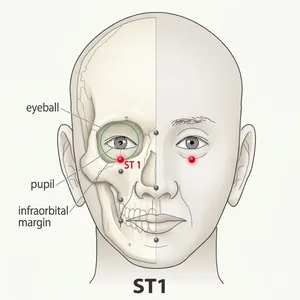
Two points take special care.Chengqi (ST-1) is pressed only as very light contact on the bony rim below the eye, never on the eyeball. Jingming (BL-1), at the inner corner of the eye, is excluded from every self-care step and is not pressed at home at all.
Stop at once and see a doctor if you get eye pain, flashes, new floaters or any change in vision, spreading redness, swelling, blistering, a headache that is new or severe, or dizziness.
The hand techniques
The whole practice uses four hand movements. They are ordinary movements with the fingertip; what matters is that the pressure is steady and the skin is not dragged.
Press 按àn
Press straight in with the pad of the finger and hold still, so the point feels firm rather than sharp.
Knead in small circles 揉róu
Keep the pad on the point and make slow circles about the width of a pea.
Push along a line 推tuī
Push the pad along the line of the channel in one direction without dragging the skin.
Smoothing strokes 抹mō
Finish with light outward strokes that smooth the skin from the midline.
Optional warm-up: the classical opening sequence
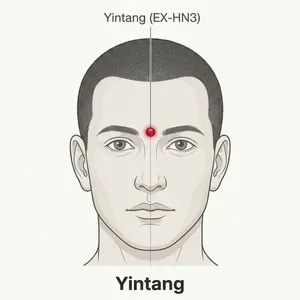
Open the heavenly gate开天门kāi tiān mén. Push from Yintang (GV24+) straight up to the hairline, six to nine slow passes.
Push the palace gate推坎宫tuī kǎn gōng. Push along each eyebrow outward from the midline, six to nine passes.
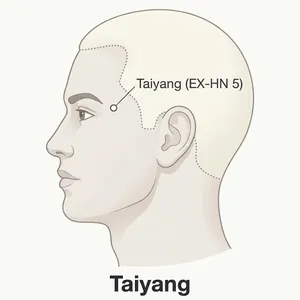
Knead Taiyang揉太阳róu tài yáng. Knead the temple hollows over Taiyang (EX-HN5) in small circles, ten to twenty seconds a side.
How it is done
Five to eight minutes, seated, with clean hands and a clean face. Press each point once and move on; there is no need to return to it.
Diagram. Filled dots are the core routine; outlined dots are the add-ons. Each dot links to its step card.Diagram. Three-quarter view: Taiyang (step 3), Xiaguan (C1) and Jiache (step 6), which read more clearly beside the ear.
Before the points: Wash your hands, cleanse the face and pat it dry. If the skin is dry, apply a drop of oil so the finger does not drag.
Core 5-minute routine
5 minutes
1Brow midline
Press between the brows with the pad of the index finger, straight in and slightly upward, for 20 to 30 seconds, or three to five slow breaths.
How to find it. Midway between the medial ends of the eyebrows, on the flat of the forehead bone. There is no notch here: what you feel is a small dip between the brow ridges.
Pad of the index fingerLight20 to 30 seconds, or 3 to 5 slow breaths
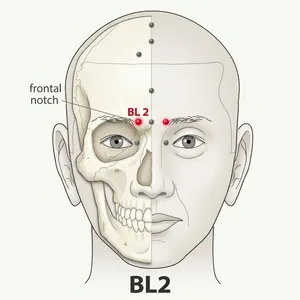
At the inner end of each eyebrow, press upward into the notch on the bone, 20 to 30 seconds a side.
How to find it. At the inner end of the eyebrow, feel for a small notch on the upper edge of the orbit; the point is in the depression just above that notch.
Pad of the index fingerLight20 to 30 seconds a side
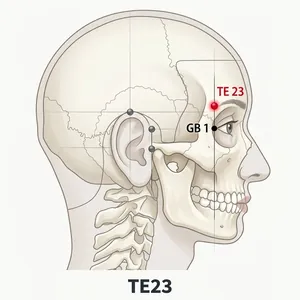
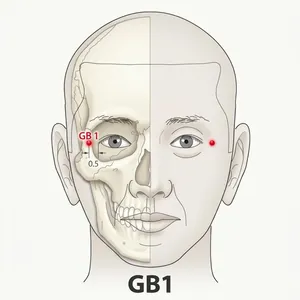
Press the outer end of each eyebrow, then the temple hollow behind it, 20 to 30 seconds a side. Press the hollow, not the pulse.
How to find it. At the outer end of the eyebrow there is a shallow depression on the bone. Behind it, about one finger-width back from the midpoint between the eyebrow end and the outer eye corner, the temple hollow is deeper and softer.
Pad of the index fingerLight20 to 30 seconds a side
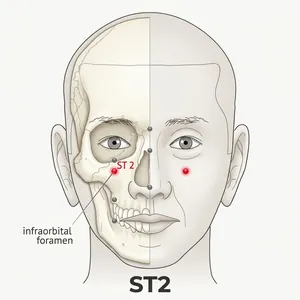
Directly below the pupil, about one finger-width below the rim of the eye socket, in the small hollow you can feel on the cheekbone. Press gently for 10 to 20 seconds a side.
How to find it. Directly below the pupil, about one finger-width below the rim of the eye socket, there is a small hollow in the cheekbone; the point sits in that hollow.
Pad of the ring fingerFeather-light10 to 20 seconds a side
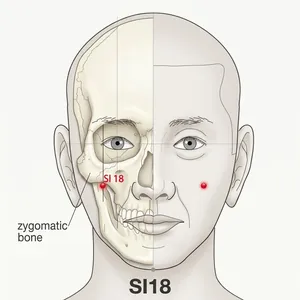
In the hollow just under the cheekbone, in line with the outer corner of the eye, 20 to 30 seconds a side.
How to find it. In the hollow just under the cheekbone, directly below the outer corner of the eye: a soft depression that deepens when the jaw is relaxed.
Pad of the index fingerLight20 to 30 seconds a side
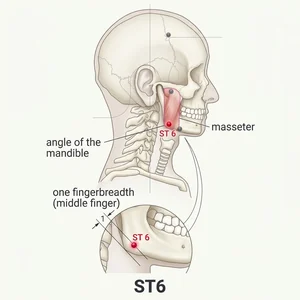
At the angle of the jaw, 15 to 20 seconds each side.
How to find it. Clench the teeth: a muscle stands out at the back of the jaw. The point is on that muscle, one finger-width in front of and above the corner of the jaw, and it feels full and slightly tender.
Pad of the index fingerLight15 to 20 seconds a side
Feather-light, on the bony rim only, after the core routine.
A1Outer eye corner
At the outer corner of each eye, in the small hollow about half a cun out from the canthus, press lightly on the bone for 10 to 20 seconds a side. This is the outer edge of the eye area, so the pressure is light and never goes towards the eyeball.
How to find it. In the small hollow about half a cun lateral to the outer corner of the eye, on the bone; the hollow is shallow and the skin over it is thin.
Pad of the ring fingerFeather-light10 to 20 seconds a side
Very light contact on the bony rim directly below the eye, 10 to 20 seconds a side. Never press inward, and never on the eyeball.
How to find it. On the bony rim directly below the pupil, between the eyeball and the lower edge of the orbit; press only on the rim, never towards the eye.
Pad of the ring fingerFeather-light10 to 20 seconds a side
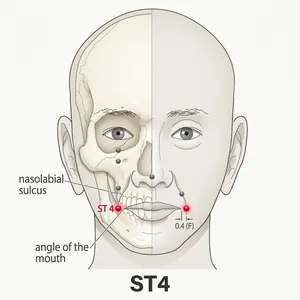
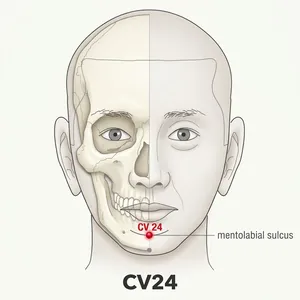
In the small groove between the middle of the lower lip and the chin, press lightly upward for 10 to 15 seconds. This is the chin and mouth area, and the pressure is light because the skin there is thin.
How to find it. In the small groove between the middle of the lower lip and the point of the chin; the point is in the dip, not on the bone.
Slow holds; skip the jaw point during an acute jaw lock.
C1In front of the ear
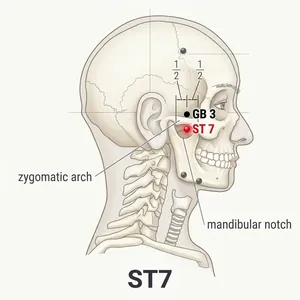
In the hollow just in front of the ear, below the cheekbone, over the jaw joint, 10 to 20 seconds a side. This is the point for jaw and cheek tension, and it is not pressed during an acute jaw lock or a painful jaw-joint episode, which needs assessment rather than acupressure.
How to find it. In the hollow just in front of the ear, below the cheekbone, over the jaw joint; you can feel the joint move under the finger when the mouth opens.
Pad of the index fingerLight10 to 20 seconds a side
At the angle of the jaw, 15 to 20 seconds each side.
How to find it. On the jaw muscle one finger-width in front of and above the corner of the jaw, where the muscle stands out when the teeth are clenched.
Pad of the index fingerLight15 to 20 seconds a side
The distal points; the pregnancy note on each card comes from that point's own page.
D1Web of the hand
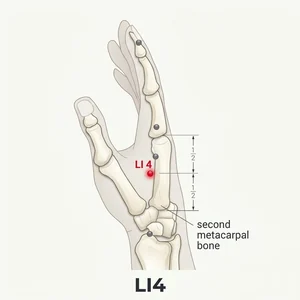
In the web between thumb and index finger of the other hand, press firmly for 20 to 30 seconds. This point is classically avoided in pregnancy and is not pressed while pregnant.
How to find it. In the web between the thumb and index finger, at the highest point of the muscle bulge when the fingers are brought together; it is usually tender.
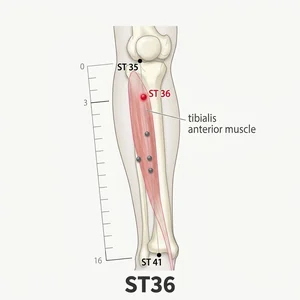
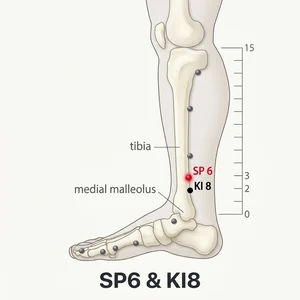
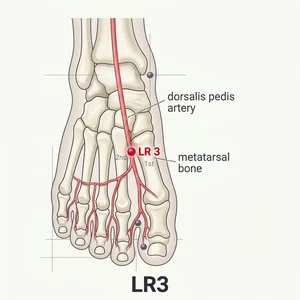
Below the knee, above the inner ankle, and on the top of the foot. Sanyinjiao is classically avoided in pregnancy and is not pressed while pregnant. Twenty seconds each.
How to find it. Zusanli: three cun below the hollow below the kneecap, one finger-width outside the shin bone. Sanyinjiao: three cun above the inner ankle bone, behind the back edge of the shin. Taichong: on the top of the foot, in the hollow where the first and second metatarsal bones meet.
Add the add-on that fits the picture, and let the whole sequence stay inside the five to eight minutes the page starts with.
Afterwards. Once or twice a day is the usual routine. The face may feel warm or slightly pink for a few minutes, which is expected. Nothing about the sequence should sting, and nothing should be pressed hard enough to leave a mark. Any product used afterwards should be one the skin already tolerates.
How it differs from cosmetic acupuncture
The points are largely the same, and the treatments are not. Acupressure presses the surface; acupuncture inserts fine needles and is done by a practitioner. A session of cosmetic-acupuncture involves a consultation, point selection, needling of the face and body, a retention period, and aftercare, and it carries the risks of any needling: bruising, minor bleeding and, rarely, infection.
That difference is not a hierarchy. Acupressure is what a person can safely do at home, and it is the version the tradition assigns to daily self-care. Cosmetic acupuncture is what a trained practitioner does, and its evidence is separate and is set out on its own page.
What the evidence says
No verified human study of a TCM intervention for the condition on this page. Editorial policy
Traditional use. No verified human study of facial acupressure for a skin outcome was found. These are the human studies we found on PubMed (searched October 2026). The two records below are the closest available, and neither is a test of this practice.
A randomised trial enrolled 90 volunteers aged 25 to 65 for four weeks and compared two home facial devices built on meridian and acupoint theory against a control group. Both device groups improved on wrinkle, texture, radiance and laxity measures, and 80 participants completed. The authors concluded that the devices need further safety verification. These are devices, not acupressure, and the trial does not test finger pressure. Bu P et al., Journal of Cosmetic Dermatology, 2025, PMID 40099405.
A second trial enrolled 40 healthy adults aged 20 to 30 and compared periocular acupressure, a facial massage roller and an automated eye massager for ocular blood flow and visual acuity. Short-term changes appeared; after 60 days of daily use the differences were no longer significant. The outcome was eye blood flow and vision, not skin. Hayashi N, Du L. International Journal of Therapeutic Massage and Bodywork, 2021, PMID 34079599.
Two small adjacent studies, neither of which tests the practice described here: that is why this page is marked Traditional use.
Common mistakes
Pressing hard because light pressure feels like nothing. A firm, steady contact through the pad of the finger is the aim; white knuckles and sore points afterwards are not.
Pressing into the eyeball. Every contact around the eye goes onto bone, and Chengqi is a still, very light rim contact and nothing more.
Working over active spots. Pressing a cyst or an inflamed follicle can spread irritation.
Using the thumbnail. The pad of the finger spreads the pressure; the nail concentrates it.
Holding your breath while pressing. The sequence is timed in breaths for a reason: three to five slow breaths is a hold.
Skipping the distal points.Hegu (LI-4), which is not pressed in pregnancy, and the leg points are part of the sequence, not an optional extra.
Doing it for twenty minutes. Five to eight minutes is the routine, and longer does not add anything.
Carrying on through pain. A point that hurts sharply is a reason to ease off, not to press harder.
Common questions
How long should I hold each point?
Twenty to thirty seconds, or three to five slow breaths, on the face. The under-eye points take less, ten to twenty seconds, because the tissue is thinner and the margin for error smaller.
Can facial acupressure lift or firm the face?
It is not described that way here, and no human study has tested it. What the tradition claims is movement of Qi and Blood along the channels. Anyone promising a lifting result is going beyond both the tradition and the evidence.
Is it safe during pregnancy?
The routine as a whole is gentle, but two of the points used most, Hegu (LI-4) and Sanyinjiao (SP-6), are classically avoided in pregnancy. They are not pressed during pregnancy, and it is worth asking your practitioner before starting a routine.
Can I do it over acne?
Not over active lesions. Pressing an inflamed follicle can spread irritation. Calm areas can be worked gently, and if the acne is widespread the routine should wait until it settles.
How is it different from gua sha?
Gua sha drags a tool across the skin along the channels; acupressure presses individual points. They are often used together, and gua-sha-face sets out the tool version.
Does it work better with oil?
A drop of oil helps the finger move without dragging on dry skin, and it is not otherwise part of the technique. Anything applied to the skin is patch tested first.
Bu P, Luo J, Wen C, et al. 2025. Evaluating the Effectiveness and Safety of Home Facial Antiaging Beauty Devices Based on Meridian and Acupoint Theory.. Journal of Cosmetic Dermatology. PMID: 40099405. Randomised controlled trial of two home devices against a control group, 4 weeks; 90 enrolled, 80 completed, aged 25 to 65; limits: Devices, not acupressure; the authors state that safety needs further verification
Hayashi N, Du L. 2021. Acute and Chronic Periocular Massage for Ocular Blood Flow and Vision: a Randomized Controlled Trial.. International Journal of Therapeutic Massage and Bodywork. PMID: 34079599. Randomised controlled trial comparing periocular acupressure, a massage roller and an eye massager; 40 healthy adults aged 20 to 30; limits: Outcome is ocular blood flow and visual acuity, not skin; effects did not persist at 60 days