
Acupoint · Acupressure only
Dicang
地仓
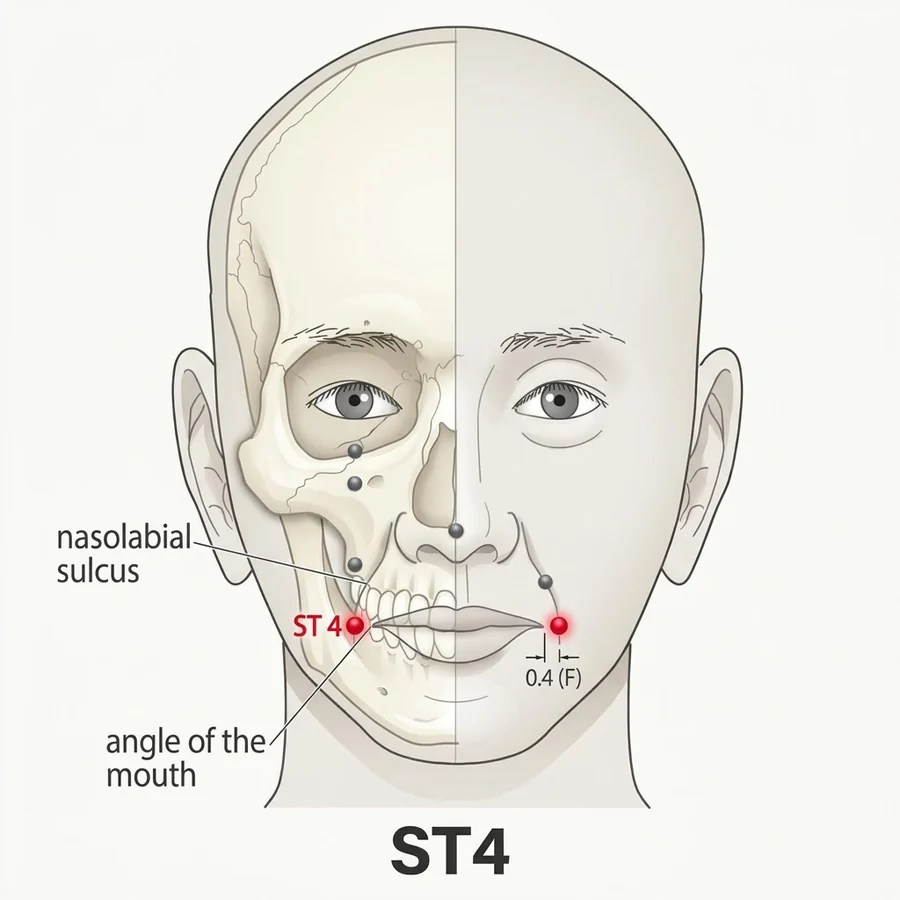
Location
Standard location. On the face, 0.4 f-cun lateral to the angle of the mouth.
How to find it. Put the tip of an index finger at the corner of the mouth, then slide it outward less than half a centimetre, into the groove between the nose and the cheek. That groove is the landmark the standard names.
0.4 f-cun is a proportional measure, less than half the width of the mouth corner itself. If the finger is out on the cheek, it has gone too far.
Acupressure
What it is used for
Skin and face
- Jaw and mouth tension, alongside Jiache (ST-6).
- The lower-face step of the sequence on facial-acupressure.
- Nasolabial tension and a heavy lower face.
- Tension after dental work, once any swelling has settled.
Actions
- Clears the channel through the lower face
- Benefits the mouth and jaw
- Relaxes the muscles around the lips
- Used with Jiache for jaw clenching
Practitioner note
Safety
Safety and when to get help
- Light pressure only. The skin at the corner of the mouth is thin and splits easily.
- Do not press on a cold sore, angular cheilitis or any broken skin at the mouth corner.
- Facial paralysis, drooling or a sudden change in the lower face needs a doctor urgently and is not treated with acupressure.
- This point is not used with strong pressure or with cupping in self-care.
- Hegu (LI-4), used with this point, is classically avoided in pregnancy and is not pressed during pregnancy.
Used with
Common questions
Where exactly is Dicang?
Just outside the corner of the mouth, in the groove between the nose and the cheek, less than half a centimetre from the lip.
Can I press it if I have a cold sore?
No. Wait until the skin has healed, because pressing can spread irritation and delay healing.
Why is it used with Jiache?
Dicang works the mouth corner and Jiache works the jaw angle; together they cover the lower-face tension that comes with clenching.
How it is understood
Dicang sits just outside the corner of the mouth, in the groove that runs from the nose to the lip. The tradition uses it for the mouth and lower face: deviation of the mouth, drooling, numbness and the after-effects of facial paralysis, all of which are practitioner territory. In an everyday facial routine it is used gently for jaw and mouth tension, together with Jiache at the angle of the jaw.
Sources
Guidelines and standards
ST-4 Dicang
On the face, 0.4 f-cun lateral to the angle of the mouth.
WHO Standard Acupuncture Point Locations in the Western Pacific Region World Health Organization, Regional Office for the Western Pacific, 2008.
Location quoted from the WHO standard. The classical record for this point has not been verified against a primary text here, so it is not quoted.