
Chinese herb · Skin edition
Zhen Zhu
珍珠 Pteria martensii or Hyriopsis cumingii (nacre)
Profile
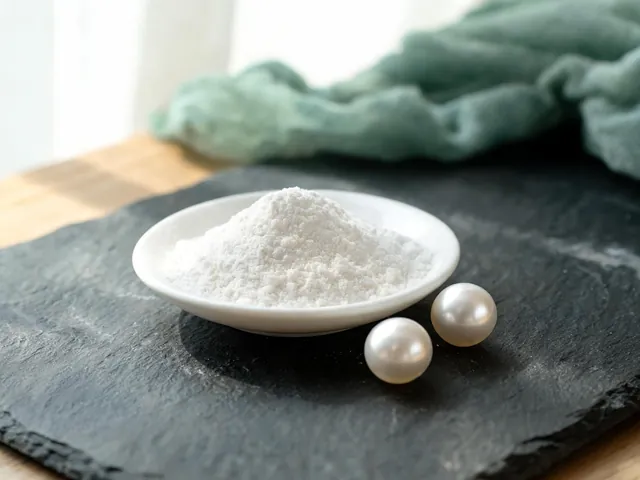
Zhen Zhu is the nacre of the pearl oyster, and the tradition keeps it for two jobs: settling the mind and putting a fine powder on the face. It is cold, salty and sweet, it enters the Heart and Liver, and it is classically described as calming the spirit, clearing the eyes and, applied to the face, making the skin moist and the complexion good.
It is a mineral and animal substance rather than a plant, which changes what matters about it. It is non-toxic, it is not a herb for internal use at home, and its cosmetic record is a face powder rather than an internal formula. The practical cautions are about adulteration, cleanliness and allergy rather than toxicity.
Skin signs
- A dull, dry complexion that has lost its lustre
- Restless sleep with a mind that will not settle, alongside skin that looks tired
- Skin that is dry but not inflamed, with a fine texture
- Sores or small ulcers that are healing slowly
When not to use it
Not for skin that is red, hot, swollen or weeping, and not for a complexion that is dark because of active inflammation, which needs treating first. It is not a treatment for pigmentation, and it is not an agent for changing the colour of the skin, whatever the historical phrasing of its cosmetic use suggests. Anyone with a shellfish allergy should not use it on the skin without advice, and a powder that has not been properly prepared should not be used at all.
What it does for the skin
The cold, salty nature is said to weigh the Qi downward and settle the Heart, which is why pearl appears in formulas for palpitations, insomnia and a mind that will not stop. On the skin this shows indirectly: the tired, dry, thin look that accompanies broken sleep is the picture it is paired with. It is not a sedative and it is not given for those reasons at home.
The classical cosmetic use is a fine powder applied to the face. The traditional reasoning is that the mineral, being heavy and slightly cold, settles a surface that looks dry and dull. It is the basis of a great many face powders historically, and of a great many products now. There is no controlled evidence for it, and the page says so.
Pearl is classically used in eye preparations, ground extremely finely, for redness, irritation and opacities. That is a practitioner and ophthalmology territory, and nothing on this page is an eye treatment. The eye use is recorded here because it explains why the mineral is classed as entering the Liver.
In the classical record pearl is used for slow-healing sores, and modern laboratory work on pearl powder has examined wound repair. That work is cellular and animal research, and it is not evidence that a face powder heals. It is recorded as laboratory work in the evidence section.
Skin conditions it is used for
| Condition | Pattern | Why it suits | Formula |
|---|---|---|---|
| Dark face | A dull surface with no active inflammation | The traditional cosmetic use is a face powder for a complexion that has lost its lustre. It suits a dull but calm surface, and it is not for skin that is dark because it is inflamed, which needs the underlying pattern treated. Modern products make the same claim from the same record, and the evidence is traditional only. | Zhen Zhu powder with Bai Zhi in a compounded face preparation |
| Skin dryness | Dry, fine-textured skin without redness | The mineral is heavy and slightly cold, and it is traditionally applied where the surface is dry and lacks lustre. It is a surface preparation rather than a treatment for a dry pattern, which is read internally as Blood or Yin deficiency and treated with formulas rather than powders. | A thin pearl powder paste, washed off after 10 to 15 minutes |
| Acne | Healing lesions rather than active inflammation | Pearl appears in the classical record for sores and slow-healing lesions, and the laboratory work on repair is the modern echo of that. It is not an acne treatment and it is not applied to active lesions, which need the acne page rather than a face powder. | Not a stand-alone preparation; see the acne page |
Combinations
- Bai Zhi (Equal small parts in a face powder). The classical pairing for a face preparation: Bai Zhi moves the stagnation that dulls the surface and Zhen Zhu supplies the fine, heavy powder base. Bai Zhi makes skin react to sunlight, so the pair is used at night and kept out of the sun.
- Bai Ji (Equal parts in a preparation for slow-healing sores). Bai Ji is astringent and promotes tissue repair, and pearl is classically used for sores that heal slowly. Both are non-toxic and both are applied rather than taken at home. The pair is historical rather than a formulation to make.
- Fu Ling (Not fixed; both in a compound powder). Fu Ling addresses the dampness that makes a complexion look heavy, while pearl addresses the dullness. The pairing is traditional in facial preparations where the skin is both dull and slightly puffy.
Formulas
- Zhen Zhu San 珍珠散. The name given to several historical powders built on pearl, used for sores and for the face. The compositions differ between texts, which is why this page describes the tradition rather than a single formula.
- An Gong Niu Huang Wan 安宫牛黄丸. A classical emergency formula in which pearl is one of the ingredients that settles the spirit. It is included here only to show where the mineral sits in the tradition, and it is not connected to any skin use.
Topical use
Zhen Zhu is used as a very fine powder, either alone or in a compounded face powder. The preparation is a thin paste made with water or a plain cream, applied for ten to fifteen minutes and washed off. The fineness matters: the classical texts insist that pearl be ground until it is as fine as flour, and a gritty powder is both useless and irritating on the face.
- Face powder paste. Blend a small quantity of fine pearl powder with water or a plain cream to a thin paste. Apply a thin layer, avoiding the eyes and lips, leave it for 10 to 15 minutes while it is still moist, and rinse with lukewarm water. Patch test first.
- Compounded powder with Bai Zhi. The historical face powder pairs pearl with Bai Zhi. Because Bai Zhi is phototoxic, the combination is used in the evening and the face is kept out of the sun afterwards. This is a historical preparation rather than a recommendation.
Patch test on the inner forearm for 24 hours. Use only powder from a supplier that states its source and purity, because pearl is expensive and adulteration with chalk or shell is common. Keep it out of the eyes, do not use it on broken skin, and stop if the skin stings.
Safety
Contraindications
- Active inflammation, redness or weeping skin. A face powder is for a calm, dull surface, and covering inflamed skin makes it worse.
- Broken or infected skin, and any open sore that has not been assessed.
- A shellfish or mollusc allergy, because pearl is nacre from a bivalve. Cross-reaction is possible and a patch test is the minimum precaution.
Pregnancy
The classical record does not list pearl as an avoided substance, and its topical use is a small exposure. It is not a routine herb in pregnancy, and any internal use belongs to a practitioner.
Interactions
- No clinically significant interaction is established for topical use.
- Poorly ground or contaminated powder is the main practical risk, not an interaction. Do not use a product whose source and composition are unclear.
Allergy
Mollusc and shellfish allergy is the one to ask about, because nacre is a bivalve product. Contact reactions to face powders are also described, and a first use should be a patch test rather than a full application.
Evidence
Ben Cao Gang Mu (Compendium of Materia Medica), Li Shizhen, Ming
Pearl is salty-sweet, cold and non-toxic. It calms the Heart and benefits the eyes, removing opacities. Applied to the face, it makes the skin moist and gives a good complexion.
This is the cosmetic line the whole modern pearl-powder trade rests on, and it is a line about the face, written in the sixteenth century.
Hai Yao Ben Cao (Materia Medica of the Sea), Tang
When pearl is used in medicine it must be ground for a long time until it is as fine as flour; if it is not ground finely enough it will injure the internal organs.
The oldest practical instruction attached to the mineral, and the origin of the insistence on fineness.
Ben Cao Jing Shu (Commentary on the Materia Medica)
Do not use it when the illness is not caused by fire-heat.
A caution that restricts it, rather than a claim: pearl is cold, and cold is wrong for a cold picture.
Ben Cao Jing Ji Zhu (Collected Annotations), Tao Hongjing, Liang
It treats opacities of the eye and stops diarrhoea.
The early use is ophthalmic and internal, not cosmetic.
A review of pearl powder in biomedical applications covers its composition, its use in wound repair and bone, and its cosmetic applications. It is a materials and laboratory review, and it does not present human trials of a face powder.
The laboratory work is consistent with the classical uses without confirming them. Nothing in it is evidence that applying pearl powder to the face changes the complexion of a person.
PubMed records
- 2021. Pearl Powder-An Emerging Material for Biomedical Applications: A Review.. Materials. PMID: 34074019. Materials review. Laboratory and materials literature; no human trial of a face preparation.
Dose
- Topical. A small quantity of fine powder for a face preparation, applied for 10 to 15 minutes and washed off. The amount is set by the area treated.
- Internal. Not for home use. Where pearl is prescribed internally it is in a formula and in a prepared, finely ground form, and the classical texts are explicit that the grinding matters.
For the face, less powder and a shorter contact time is always the better first attempt, and the fineness of the grind matters more than the quantity. Internally, pearl belongs to a practitioner and to prepared formulas, not to a powder bought for cosmetic use.
Profile note
Zhen Zhu is a face powder with a mind-calming history, not an ingredient for changing skin colour. Its cosmetic use is a sixteenth-century line about moistening the skin and giving a good complexion, and this page keeps it at that: a historical face preparation with no controlled evidence, a real allergy caution, and an insistence on fineness and purity.
Sources
- Ben Cao Gang Mu (Compendium of Materia Medica), Li Shizhen, 1578 - classical entry quoted above.
- Hai Yao Ben Cao (Materia Medica of the Sea), Tang dynasty - classical entry quoted above.
- Ben Cao Jing Shu (Commentary on the Materia Medica) - classical entry quoted above.
- Ben Cao Jing Ji Zhu (Collected Annotations on the Classic of Materia Medica), Tao Hongjing, Liang dynasty - classical entry quoted above.
- Pharmacopoeia of the People's Republic of China - source material, preparation and quality requirements for Zhen Zhu.