Chinese herb · Skin edition
Bai Fu Zi
白附子 Typhonium giganteum (禹白附). The classical name covered two plants; see identity_note.
Two plants share this name
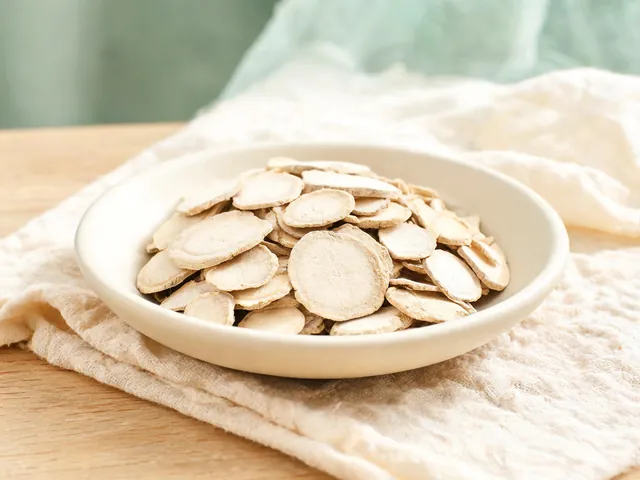
This page covers Typhonium giganteum (禹白附, Yu Bai Fu), the plant that the Pharmacopoeia lists as Bai Fu Zi today.
The classical cosmetic lines quoted on this page were most likely written about Guan Bai Fu (关白附, Aconitum coreanum), which is an aconite. The older materia medica entries fit that identification better than they fit Typhonium, and the Ben Cao Gang Mu's note that the herb came from Korea fits it too.
So the traditional cosmetic record and the modern drug are not necessarily the same plant. The history is real, and it may be a history of an aconite rather than of the tuber sold under the name now.
Never buy Bai Fu Zi without the Latin name on the label. Here the one name covers two different plants with different toxicity, and a product that does not say which one you have cannot be assessed at all.
Profile
Two things have to be said about Bai Fu Zi before anything else. The first is that it is a toxic raw herb: the untreated tuber contains needle-shaped calcium oxalate crystals that damage mucous membranes. Eating it causes severe swelling of the mouth and throat, and in related Typhonium species this has been severe enough to need emergency airway management. It is used only in its processed form, and only under supervision.
The second is that it has the strongest classical cosmetic line of any herb in this section. The Tang materia medica of the sea records it as 「入面脂皆好也」, excellent when added to a facial fat, and it appears in both the Tang and Song facial chapters. That record carries a large qualification, set out in the box below: the plant the classical authors were describing is probably not the one that carries the name in the Pharmacopoeia today.
Skin signs
- A dull complexion with a thick or stagnant quality, as described in the facial chapters
- Raised or uneven marks and scars, where it appears in classical scar preparations
- Firm, settled nodules read as phlegm
- Facial twitch or a Wind picture in which the herb appears in compound formulas
When not to use it
Not in the raw form, ever, and not at home in any form. Not for use inside the mouth, on broken skin, on the eyelids, or on a child. Not in pregnancy. Not alongside aconite-family herbs without practitioner review. Not for anyone with an allergy to the Araceae family. Not as a cosmetic ingredient chosen by a reader from this page: the classical facial use is a practitioner and manufacturer matter, and the dose that injured people was small.
What it does for the skin
The raw tuber contains needle-shaped calcium oxalate crystals, and the clinical picture is of mechanical injury to the mouth, throat and gut. Eating it causes numbness and severe swelling of the lips, tongue and throat, drooling, severe throat pain, nausea and abdominal pain. In the one published case series, of a related Typhonium species, one of four patients developed upper airway oedema severe enough to need emergency endotracheal intubation, and all four recovered with adrenaline nebulisation, antihistamines and steroids. The Pharmacopoeia requires processing with ginger and alum, which reduces the toxicity. Nothing on this page is a home preparation.
The classical indications are 面上百病, all the diseases of the face: the herb is said to ascend, disperse and drive other medicines to the face. That is the reasoning behind its presence in facial preparations and in formulas for facial paralysis, and it is a practitioner rationale applied to a toxic herb.
Verified: it is an ingredient of the Tang facial fat and the jade facial ointment, and the Song facial chapter gives a Bai Fu Zi ointment for facial spots whose stated aim is to make the face lustrous. The historical use is not in doubt. What it does not establish is safety, and the texts themselves rate the herb as slightly toxic.
It appears in the Song scar ointment alongside Bai Jiang Can, and the traditional aim is to soften and settle a raised mark. No controlled evidence supports the use, and a keloid or a scar that is still forming needs a dermatology assessment.
Skin conditions it is used for
| Condition | Pattern | Why it suits | Formula |
|---|---|---|---|
| Dark face | A stagnant, thickened complexion picture | This is the classical cosmetic territory, and it is the reason the herb is on the site at all. It is included with the warning intact: the use is historical, the herb is toxic, and no reader should compound a preparation from this page. | Historical facial preparations only; not a home formula |
| Keloids | A raised scar with Wind and phlegm read into it | Verified from the Song scar ointment, which combines it with Bai Jiang Can. A keloid should be assessed by a dermatologist, and a traditional scar ointment is not a substitute for that assessment. | Song scar ointment, historically; not a home preparation |
| Acne | Settled nodules read as phlegm rather than active heat | In classical practice it is a supporting herb in formulas for firm nodules, and it is not a treatment for active inflamed acne. The toxicity means it is never a self-treatment, whatever the pattern. | Not a stand-alone preparation |
Combinations
- Bai Jiang Can (Historical ratio in a scar ointment). The Song scar ointment pairs the two. Both are recorded here as history rather than as a preparation, and the pairing is one of the few places where the classical scar logic is explicit.
- Bai Zhi (Historical facial preparation). The Tang facial fat lists them together, with Bai Zhi carrying the preparation to the face. Bai Zhi too has a sun-sensitivity caution, so the pair carries two cautions rather than one.
- Chuan Xiong (Practitioner formula only). The classical reasoning is that the acrid warmth drives other medicines upward to the face, and Chuan Xiong does the moving. This is a formula-level pairing, not something to combine at home.
Formulas
- Bai Fu Zi Ointment 白附子膏. The Song facial chapter's own formula, whose stated aim is to make the face lustrous. It is named here as a historical entry, not as a composition to reproduce.
- Qian Zheng San 牵正散. A classical formula for facial paralysis that contains Bai Fu Zi alongside Quan Xie and Bai Jiang Can. Both Bai Fu Zi and Quan Xie are toxic, and the formula is a practitioner matter entirely.
Topical use
Bai Fu Zi appears in classical facial preparations, and this page does not give a preparation for a reader to make. The raw tuber is toxic on contact with mucous membranes, the processing that reduces its toxicity is a manufacturer's process, and the historical recipes include other substances that are no longer used.
- Processed material only. Any topical use in the tradition uses the processed tuber, prepared to the standard in the Pharmacopoeia, and coming from a supplier who states the processing. The raw material should not be handled for a preparation.
- Not a home preparation. There is no home version of this. A facial preparation containing the herb is a manufactured product or a practitioner's compounded medicine, and the difference is the processing.
Keep away from the eyes, lips, broken skin and the inside of the mouth. Patch test for 24 hours on the forearm before any use, and wash hands after handling. Stop at once for stinging, numbness, swelling or blistering, and seek medical help if any of those is severe or spreads.
Safety
Contraindications
- The raw, unprocessed tuber in any form. It irritates mucous membranes, and ingestion has caused severe poisoning and death.
- Broken skin, the eyelids, the lips, the inside of the mouth or the eyes.
- Pregnancy, because the herb is toxic and rated as such in the classical literature.
- Children, and anyone handling the material without washing their hands afterwards.
- Aconite-family herbs without practitioner review, and any formula containing other toxic herbs.
- An unexplained or changing skin lesion, which needs a diagnosis rather than a preparation.
Pregnancy
Avoid. The herb is classically rated as slightly toxic, and its classical formulas are not pregnancy-safe. There is no topical dose that a pregnant reader should use without a practitioner.
Interactions
- Other toxic herbs. Classical formulas combine it with Quan Xie and other toxic materials, and the combination multiplies the risk rather than adding it.
- Aconite-family herbs (Chuan Wu, Cao Wu, Fu Zi). The overlap in toxicity and in processing requirements makes the combination a practitioner-only matter.
Allergy
The Araceae family, which includes taro and dieffenbachia, is the cross-reaction to ask about, and contact with the raw tuber is itself an irritant reaction rather than an allergy. A first use of any processed product should be a patch test.
Evidence
Ming Yi Bie Lu (Supplement to the Classic of Materia Medica), Tao Hongjing
It treats heart pain, blood impediment, all the diseases of the face, and it drives the force of other medicines.
面上百病, all the diseases of the face, is the line the entire facial reputation rests on.
Hai Yao Ben Cao (Materia Medica of the Sea), Tang
Very warm, slightly toxic. It treats scabies, ringworm, wind sores, scars on the head and face, dampness below the scrotum, weakness of the legs and all wind and cold conditions. Excellent when added to a facial fat.
The strongest cosmetic line of any herb in this section, and the same entry that records its toxicity. Both facts belong on the page.
Ben Cao Jing Shu (Commentary on the Materia Medica)
Its nature is drying and ascending; it is a yang herb among wind medicines. Wind by nature rises; its acrid warmth excels at dispersing, and therefore it governs all the diseases of the face and drives the force of other medicines.
The mechanism the tradition gives for the facial use: it ascends, and it carries other herbs with it.
Ben Cao Gang Mu (Compendium of Materia Medica), Li Shizhen, Ming
Bai Fu Zi is a medicine of the Yangming channel. It received this name because it resembles Fu Zi, but it is in fact not of the aconite class at all. The entry records the herb as coming from Korea.
This is the passage at the centre of the identity problem. Li Shizhen explicitly denies that the herb is an aconite, and records it from Korea. Modern botanical identification reads most premodern 白附子 entries, this one included, as 关白附, Aconitum coreanum, which is an aconite despite the disclaimer.
Sheng Ji Zong Lu, juan 101, facial section (Song, 1111 to 1117)
A Bai Fu Zi ointment, for facial spots, making the face lustrous.
The Song imperial formulary gives a facial formula its own name, which is the strongest classical attribution of the cosmetic use.
The clinical picture of Typhonium poisoning is documented for a related species. A case series of four patients who ate the raw tuber of Typhonium trilobatum describes swelling of the lips and tongue, drooling and severe throat pain, with one patient needing emergency intubation for upper airway oedema; the authors attribute the symptoms to the local effect of calcium oxalate crystals in the tuber. That paper is about a different species, and it is cited here as the closest verified record. No published case series specific to Typhonium giganteum was found.
No human trial of Bai Fu Zi for a skin condition was found, and it would be unethical to run one on the raw herb. The page is marked Traditional use and the toxicity is the more important content.
PubMed records
- 2020. The First Case Series Report of Typhonium trilobatum Tuber Poisoning in Humans.. Indian Journal of Critical Care Medicine. PMID: 32963444. Case series (4 patients). A related Typhonium species, not Typhonium giganteum; cited as the closest verified record of the toxidrome.
Dose
- Internal (practitioner, processed). 1.5 to 6 g of the processed tuber in a formula, under supervision. The raw tuber is not a medicine at any dose.
- Topical. Only in a manufactured or practitioner-compounded preparation using processed material. No home dose exists.
The only dose that matters on this page is the one that is not to be used: the raw tuber, at any amount, by anyone, at home. Processed material in a formula is a practitioner decision, and the classical topical preparations are history rather than instruction.
Profile note
Bai Fu Zi is the clearest case in this compendium of a herb whose cosmetic record, whose toxicity and whose botanical identity all have to be written on the same page. The classical facial use is verified and specific. The raw tuber is a serious poison that has caused airway compromise in related species. And two plants have shared the name, one of them an aconite, so a product without a Latin name cannot be assessed at all.
Sources
- Ming Yi Bie Lu (Supplement to the Classic of Materia Medica), Tao Hongjing, Southern and Northern Dynasties - classical entry quoted above.
- Hai Yao Ben Cao (Materia Medica of the Sea), Tang dynasty - classical entry quoted above.
- Ben Cao Jing Shu (Commentary on the Materia Medica) - classical entry quoted above.
- Ben Cao Gang Mu (Compendium of Materia Medica), Li Shizhen, 1578 - classical entry quoted above.
- Sheng Ji Zong Lu (imperial medical bureau, Song, 1111 to 1117), juan 101, 面体门 - facial formula quoted above.
- Pharmacopoeia of the People's Republic of China - toxicity rating, processing requirement and quality standards for Bai Fu Zi.
- Anandhi D, Prakash Raju K, Pillai VM, Kumaresan V. The First Case Series Report of Typhonium trilobatum Tuber Poisoning in Humans. Indian Journal of Critical Care Medicine, 2020;24(7):581-584. PMID 32963444 - cited for the related-species toxidrome.