
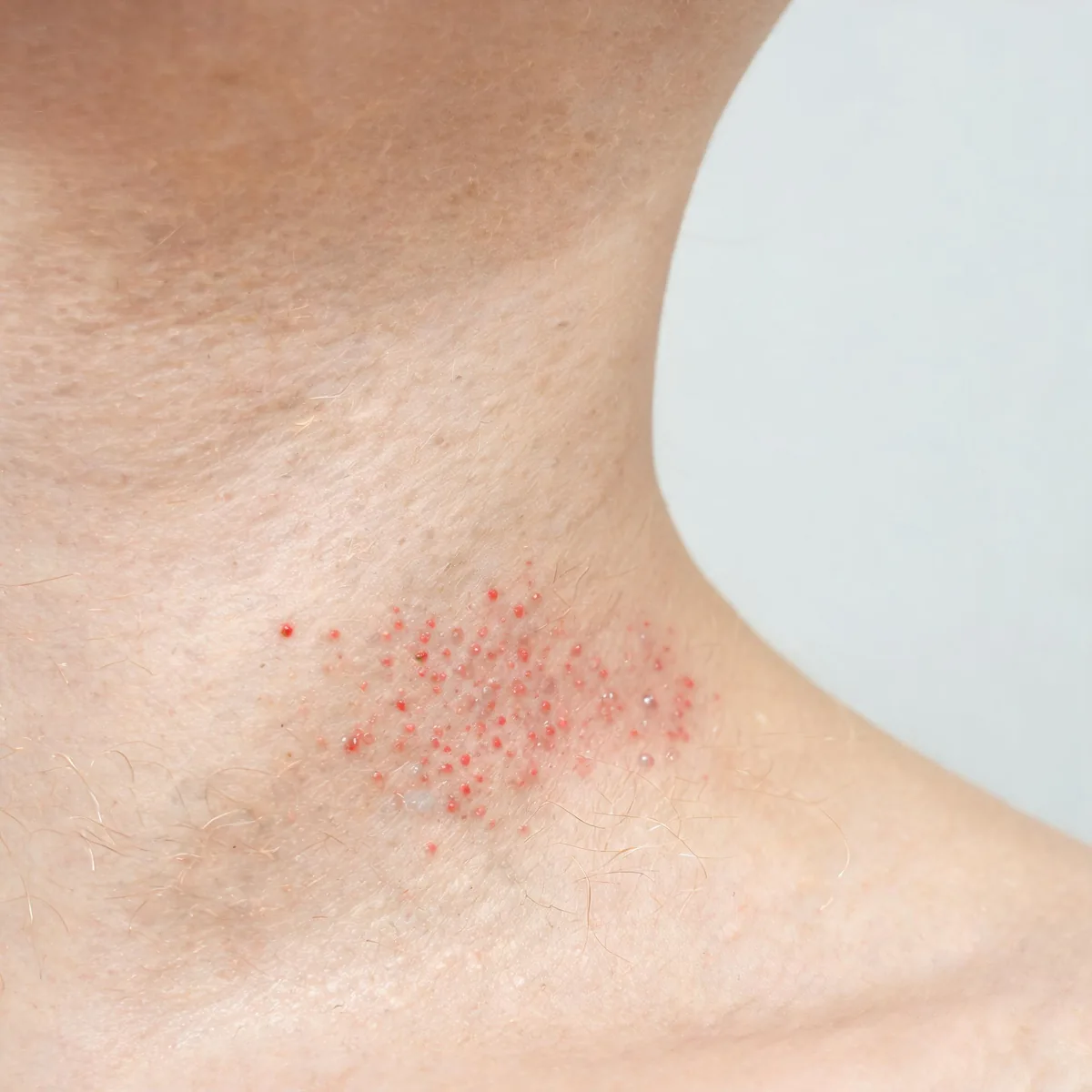
Which type is yours?
Heat rash is blocked sweat pores, but the classical literature says the root is internal: dampness and heat that the skin cannot vent. The weather triggers it; the pattern explains why it keeps returning.
Damp-Heat in Stomach and Spleen
Red oozing rash with oily skin and a greasy coating.
Looks like: Red oozing rash with oily skin
Read about this typeHeat in the Blood
Red oozing rash with intense itch worse with warmth.
Looks like: Red oozing rash with oily skin; Rash worse at night
Read about this typeSpleen Deficiency with Dampness
Pale dull-red rash recurring each warm season with fatigue.
Looks like: Pale or dull-red rash
Read about this typeEmpty-Heat caused by Yin Deficiency
Burning dry rash without oozing, worse at night.
Looks like: Burning dry rash without oozing; Dry mouth with desire for small sips
Read about this typeNot sure which? Take the Pattern check
Compare the typesWhere the spots sit, what they look like, the tongue and the main formula
Four patterns are described, and the first question to settle is whether the rash is wet or dry. A red rash that oozes, with oily skin, a greasy yellow tongue coat and loose sticky stools, is Damp-Heat in the Stomach and Spleen: the ordinary summer picture. A rash that is bright red or purplish, burns, and itches worst at night, in a restless person who wants cold drinks, is Heat in the Blood, where the heat has gone deeper than the surface. Both are excess and both are cleared. The second question is whether the person is depleted. Pale or dull red bumps returning each warm season alongside fatigue, poor appetite and loose stools point to Spleen Deficiency with Dampness, where fluids cannot be moved. A dry burning rash with no oozing, worse in the afternoon or evening, with night sweats and a dry throat, points to Empty-Heat from Yin deficiency, and that needs building, not clearing.
| Pattern | Key signs | Tongue |
|---|---|---|
| Damp-Heat in Stomach and Spleen | Red oozing rash with oily skin | Body: Red, possibly swollen with teeth marksCoat: Thick, yellow and greasy in the centre and root |
| Heat in the Blood | Red oozing rash with oily skin; Rash worse at night | Body: Deep red, often with red points or pricklesCoat: Thin, yellow and dry |
| Spleen Deficiency with Dampness | Pale or dull-red rash | Body: Pale and swollen, often with teeth marks along the edgesCoat: White, greasy and moist, thick in the middle |
| Empty-Heat caused by Yin Deficiency | Burning dry rash without oozing; Dry mouth with desire for small sips | Body: Red, thin and dry, often crackedCoat: Little or none; the tongue may look peeled |
Damp-Heat in Stomach and SpleenRed oozing rash with oily skin and a greasy coating.
Avoid in pregnancy Caution in pregnancy
Red oozing rash with oily skin and a greasy coating.
Rich, spicy food and humid weather give the Stomach and Spleen more than they can process, so fluids stop moving and turn into Dampness while the heat keeps them sticky. That mixture rises, blocks the pores and traps sweat just under the surface. The rash that follows is red, itchy and greasy, and it is usually worst where skin meets skin, because that is where moisture collects and cannot escape.
The tongue is red and may be swollen with teeth marks, carrying a thick yellow greasy coat at the centre and root, and the pulse is soggy and fast or slippery and fast, strongest at the right Guan position. Hot humid weather, spicy or greasy food and alcohol all aggravate it, while a cool dry room, plain food, mung bean soup and a cool shower settle it. Huang Qin, Zhi Zi and Gan Cao are the herbs usually named, and the points are LI-4 Hegu, LI-11 Quchi, DU-14 Dazhui and BL-13 Feishu.
Signs
- Red oozing rash with oily skin
- Thick yellow greasy coating
- Sticky or bitter taste
- Bloating with loose sticky stools
Diet and lifestyle for this pattern: Keep the skin cool and dry with loose cotton clothing and cool showers. Avoid heavy, greasy, spicy and deep-fried food, limit alcohol and sugar, drink plenty of water and include cooling, Dampness-draining food such as mung bean soup, cucumber and watermelon.
Heat in the BloodRed oozing rash with intense itch worse with warmth.
Avoid in pregnancy Caution in pregnancy
Red oozing rash with intense itch worse with warmth.
When heat passes beyond the surface and enters the Blood, it stirs the Blood and pushes it outward, which is why the rash is bright red or purple and feels hot rather than merely itchy. The intense itch is read as internal Wind generated by the heat. Because heat also burns up fluids, the skin feels dry at the same time, and the nights are worst, since Yin should be cooling the Blood then and is too depleted to do it.
The tongue is deep red with red prickles and either a thin dry yellow coat or very little coat, and the pulse is rapid and wiry. Hot weather, spicy food, alcohol and emotional stress all add fuel, and the itching and burning build through the evening. Cool drinks, light food, a cool room, a gentle compress and rest all help. The formula named for this pattern clears heat from the Blood and cools it, often adjusted with Jing Jie or Fang Feng for the itch, and the herbs include Shui Niu Jiao, raw Rehmannia, Mu Dan Pi and Chi Shao. The points are DU-14 Dazhui, LI-4 Hegu, LI-11 Quchi, SP-10 Xuehai and SP-6 Sanyinjiao.
Signs
- Red oozing rash with oily skin
- Intense itching worse with warmth
- Rash worse at night
- Internal heat with thirst for cold drinks
Diet and lifestyle for this pattern: Eat plenty of cooling food such as cucumber, watermelon and mung beans, and drink cool rather than iced fluids such as chrysanthemum tea. Strictly avoid spicy, greasy and fried food as well as alcohol and coffee, which add Heat, keep the skin cool and dry in loose cotton, use a fan or air conditioning to prevent overheating, and a gentle cool compress soothes the burning itch.
Spleen Deficiency with DampnessPale dull-red rash recurring each warm season with fatigue.
Avoid in pregnancy Caution in pregnancy
Pale dull-red rash recurring each warm season with fatigue.
Here the problem is capacity rather than excess. When Spleen Qi is weak it cannot transform and transport fluids, so Dampness gathers inside, and in hot humid weather that accumulated dampness is pushed out to the skin, where it congests the pores. Because the weakness has not changed, the rash returns each warm season, and it is pale or dull red rather than fiery, with fatigue behind it.
The tongue looks pale and puffy, marked by the teeth at its edges, coated white and greasy, and moist. The pulse is soggy and slow, soft and without force. Overwork, worry, cold raw food and humid weather all make it worse, while rest, warm cooked meals, gentle walking and a cool dry environment help. Shen Ling Bai Zhu San is the formula, with Bai Zhu, Dan Zhu Ye and Bai Xian Pi among the herbs, and the points are SP-6 Sanyinjiao, ST-36 Zusanli, SP-9 Yinlingquan and REN-12 Zhongwan.
Signs
- Pale or dull-red rash
- Recurrent episodes in warm weather
- Fatigue with poor appetite
- Abdominal bloating and loose stools
Diet and lifestyle for this pattern: Eat warm cooked meals and avoid raw, cold and greasy food that burdens the Spleen. Include ginger and lightly cooked vegetables to support digestion, and wear breathable fabrics so sweat can evaporate and Dampness does not settle on the skin.
Empty-Heat caused by Yin DeficiencyBurning dry rash without oozing, worse at night.
Avoid in pregnancy Caution in pregnancy
Burning dry rash without oozing, worse at night.
Yin is the body's cooling and moistening reserve, and when it is chronically low the warmth it normally anchors drifts upward. That unanchored heat reaches the skin and produces a rash that is red, dry and burning without any oozing, because the difficulty is a lack of moisture rather than an excess of dampness. It flares in hot weather, worsens as the day goes on and is worst at night, when Yin should be at its strongest and is not.
The tongue is red, thin and dry with cracks and little or no coat, and the pulse is fine and rapid. Spicy or fried food, late nights, overwork, hot humid weather and heavy sweating all deplete Yin further and stir the heat, while a cool dry room, hydrating food, rest and moisturising skincare soothe it. Zhi Bai Di Huang Wan is the formula, with Zhi Mu, Huang Bo and raw Rehmannia among the herbs, and the points are KI-3 Taixi, KI-6 Zhaohai, SP-6 Sanyinjiao and LI-11 Quchi.
Signs
- Burning dry rash without oozing
- Worse at night or in hot weather
- Night sweats and five-palm heat
- Dry mouth with desire for small sips
Diet and lifestyle for this pattern: Keep the body cool and well hydrated. Eat moistening, Yin-nourishing food such as pear, cucumber, tofu and congee, and avoid spicy, fried and drying food that depletes Yin. Rest and avoid late nights, since sleep is when the body regenerates Yin, use gentle fragrance-free skincare, and avoid hot showers that dry the skin further.
What you can do
Start with the daily measures that match your type. Herbs and formulas come after these, and only with a practitioner.
- Damp-Heat in Stomach and Spleen: Keep the skin cool and dry with loose cotton clothing and cool showers. Avoid heavy, greasy, spicy and deep-fried food, limit alcohol and sugar, drink plenty of water and include cooling, Dampness-draining food such as mung bean soup, cucumber and watermelon.
- Heat in the Blood: Eat plenty of cooling food such as cucumber, watermelon and mung beans, and drink cool rather than iced fluids such as chrysanthemum tea. Strictly avoid spicy, greasy and fried food as well as alcohol and coffee, which add Heat, keep the skin cool and dry in loose cotton, use a fan or air conditioning to prevent overheating, and a gentle cool compress soothes the burning itch.
- Spleen Deficiency with Dampness: Eat warm cooked meals and avoid raw, cold and greasy food that burdens the Spleen. Include ginger and lightly cooked vegetables to support digestion, and wear breathable fabrics so sweat can evaporate and Dampness does not settle on the skin.
- Empty-Heat caused by Yin Deficiency: Keep the body cool and well hydrated. Eat moistening, Yin-nourishing food such as pear, cucumber, tofu and congee, and avoid spicy, fried and drying food that depletes Yin. Rest and avoid late nights, since sleep is when the body regenerates Yin, use gentle fragrance-free skincare, and avoid hot showers that dry the skin further.
Everyday habitsDiet and routine advice for every type
- Favour cooling light food such as mung beans, cucumber, watermelon, winter melon and barley tea.
- The general rule is cooling, light food that does not tax the Spleen, so cucumber, mung beans, winter melon, watermelon and chrysanthemum tea, with barley water to drink and smaller meals if digestion feels sluggish. Spicy, greasy and fried food, alcohol and excess dairy or sugar all generate Damp-Heat and can trigger a rash within hours. Pattern detail refines it. Damp-Heat needs loose cotton, cool showers and less sugar and alcohol. Heat in the Blood needs cooling food, cool rather than iced drinks and a firm break from spice. Spleen deficiency needs warm cooked meals, ginger and no raw cold food. Yin deficiency needs pear, tofu, congee and enough rest.
Beauty practices:
What a practitioner might use
Herbs are prescribed to the pattern by a qualified practitioner. Do not self-prescribe.
Avoid in pregnancy Caution in pregnancy
Acupoints 10
Formulas 1
Herbs 10
What each one is used for is in the notes below.
Herbs, formulas and acupointsPrinciples, the herbs and points used, and what to expect
Avoid in pregnancy Caution in pregnancy
How the tradition treats heat rash, with the herbs, formulas and points used for it.
Principles
- Cool the skin and clear heat while the rash is active.
- Drain dampness where the rash oozes and the skin is oily.
- Support the Spleen where the rash returns each warm season.
- Keep the skin cool, dry and unoccluded, which both frameworks treat as basic care.
- Two things are always being done at once: cooling the surface and correcting whatever allowed heat and dampness to gather. Which herbs do that depends on the pattern, since cooling the Blood, draining dampness and strengthening the Spleen pull in different directions, and a formula that suits an oozing summer rash will not suit a dry deficiency rash. Cooling washes and compresses are used on the skin while the internal work goes on, and keeping the body cool, avoiding heat-generating food and supporting digestion are treated as part of the prescription rather than as advice alongside it.
Herbs used
Formulas
- Shen Ling Bai Zhu San
- Zhi Bai Di Huang Wan
Acupoints
- LI-4 (Hegu)Avoid in pregnancy
- LI-11 (Quchi)
- DU-14 (Dazhui)
- BL-13 (Feishu)
- SP-10 (Xuehai)
- SP-6 (Sanyinjiao)Avoid in pregnancy
- ST-36 (Zusanli)
- SP-9 (Yinlingquan)
- zhongwan-ren-12
- KI-3 (Taixi)
- KI-6 (Zhaohai)
What to expect
- Heat rash is described as settling within days to two weeks with cooling and treatment.
- Recurrence each summer is expected if the Spleen pattern remains.
- Pus or spreading redness indicates infection and needs medical review.
- Acute Damp-Heat and Heat in the Blood usually fade in days to a couple of weeks once cooling treatment and dietary change are in place, and the itching settles before the colour does. Chronic patterns take longer: three to six weeks is a reasonable expectation for a meaningful reduction in outbreaks, with the aim being fewer and milder episodes rather than one perfect summer. Recurrence is expected if the Spleen or Yin remains weak, so treatment usually continues after the skin clears.
Formulas often used
Safety and when to see a doctor
Seek medical help urgently for
- Signs of infection: pus, spreading redness, warmth or increasing pain.
- Rash with fever or feeling unwell.
- Heat rash with dizziness, confusion or collapse, which may indicate heat exhaustion.
Avoid in pregnancy
Some herbs and points named on this page carry pregnancy warnings. They are marked where they appear, and each links to its own safety notes.
Cautions
- Avoid occlusive clothing and heavy creams that block sweat pores.
- Keep the skin cool and dry; do not over-bundle infants.
- Persistent or infected rashes need medical review.
Using this alongside conventional care
- TCM is described as complementary to conventional care: cooling measures and prescribed topical treatment continue alongside herbs.
- Calamine lotion, cooling measures and over-the-counter antihistamines can all be used alongside herbs, and there are no major interactions to worry about. Tell the practitioner about every cream and medicine, particularly a prescription topical steroid, because thinning skin needs monitoring and the herbal plan may need to allow for it. Nothing prescribed should be stopped abruptly. In practice the two sides do different jobs: the conventional measures soothe the surface while the formula works on the internal pattern, and neither interferes with the other.
If you're pregnant
Heat rash is common in pregnancy: progesterone raises body temperature and sweating, skin folds deepen, and the tradition reads the result as pregnancy-related Yin deficiency combined with Damp-Heat. Treatment has to be adjusted. Strongly Blood-moving and very cold herbs, Chuan Xiong, Tao Ren and Da Huang among them, are avoided, and even Huang Qin is used only with care under professional guidance. Acupressure on LI-4 Hegu and SP-6 Sanyinjiao is avoided because those points can stimulate the uterus. Gentle cooling food such as mung bean soup and external washes with Jin Yin Hua are the safer options.
If you're breastfeeding
Anything taken internally can reach breast milk. Bitter-cold herbs such as Huang Lian and Zhi Zi may leave a nursing infant with diarrhoea or digestive upset, so they are generally avoided. For a damp-heat rash, milder options such as Dan Zhu Ye and Bai Xian Pi can be applied to the skin in a wash or a compress. Acupuncture is safe while breastfeeding, but tell the practitioner, so that points which might affect milk supply are left out.
If treating a child
Infants and young children get heat rash easily because their sweat glands are immature and they overheat quickly. The two pictures usually seen are the damp-heat one, often from too many layers or hot weather, and, in babies whose digestion is weak and whose stools are loose, Spleen Deficiency with Dampness. Doses are much smaller, typically a quarter to a half of the adult amount depending on age, and treatment often relies on external washes such as a Jin Yin Hua bath. Gentle acupressure at LI-11 Quchi and ST-36 Zusanli can help, though needling is seldom used. Cool, dry skin matters most.
If treating an elderly patient
Heat rash is less common in older people but appears in bedbound patients and during heatwaves, and the picture is more often Spleen Deficiency with Dampness, or else Empty-Heat from Yin deficiency, since Qi and Yin decline with age. Treatment is gentle: harsh drying herbs are avoided because they damage Yin further, and doses are lower. Acupuncture is well tolerated, with care over blood-thinning medication. Restoring Spleen function with congee and cooked vegetables, and keeping the skin clean and dry to prevent secondary infection, matter as much as the herbs.
Urgent-sign guidance is based on standard sources: NHS anaphylaxis, NHS cellulitis, NHS Stevens-Johnson syndrome, NHS melanoma.
Avoid in pregnancy
For anything severe, sudden or spreading quickly, read when a skin problem needs urgent care.
Understanding
The tradition describes heat rash as a problem of blocked sweat pores whose root cause lies inside the body, with the Lungs and Spleen involved.
The Spleen transforms food and fluids into usable energy and moisture. When it is overloaded, dampness and heat accumulate and the skin cannot vent them, so a rash appears in hot weather and in skin folds.
Read more about how Heat rash is understood
Damp-Heat in the Stomach and Spleen gives a red oozing rash with oily skin, a thick yellow greasy coating, a sticky or bitter taste, bloating and loose sticky stools. Heat in the Blood gives a red oozing rash with intense itch worse with warmth and at night, with internal heat and thirst.
Spleen deficiency with dampness gives a paler or dull-red rash that recurs each warm season, with fatigue, poor appetite and loose stools. Empty-Heat from Yin deficiency gives a burning dry rash without oozing, worse at night or in hot weather, with night sweats and five-palm heat.
The surface problem is a blocked sweat pore, but the reason the pore blocks is internal. The Lungs govern the skin and the opening and closing of the pores, and the Spleen turns food and drink into the fluids that keep the skin supplied and the ducts clear. When humid weather, rich food or plain exhaustion overload the Spleen, fluids stop being transformed properly and gather as Dampness. Summer Heat then pushes that Dampness out to the surface, where it congests the pores, traps sweat underneath and produces the rash.
The patterns that follow are not variations on one theme. Where heat and dampness are both in excess, the result is the familiar red, greasy, oozing rash of summer. Where heat has gone deeper, into the Blood, the rash turns bright red or purplish and burns, and it itches hardest at night. Where the Spleen has too little strength to move fluids, even on a reasonable diet, the rash looks pale rather than fiery, comes and goes, and repeats each warm season. Where Yin is depleted, the rash is dry and burning with no oozing at all. The practical consequence is that some rashes need clearing and others need building, and using the wrong approach can make the one in front of you worse.
How it connects
Heat rash often appears alongside digestive complaints such as acid reflux, bloating and belching because they share a root in Damp-Heat in the Stomach and Spleen. When the middle burner is overwhelmed by rich food and humid weather, the same internal Heat and Dampness that steam upward to clog the skin pores also disrupt the Stomach's downward flow, causing reflux and bloating; treating the Damp-Heat at source often clears skin and digestion together. With Spleen deficiency with Dampness, the weakened digestive system cannot manage fluids, so Dampness collects internally and seeps outward to the skin, often with loose stools, fatigue and heaviness alongside a pale recurrent rash. Because skin and gut are affected by one weakness, strengthening the Spleen is key to both.
The conventional viewHow conventional medicine describes and treats Heat rash
Heat rash, also called miliaria or prickly heat, happens when sweat ducts block and sweat is trapped under the skin. It shows as small red bumps or itching blisters, usually in skin folds or under clothing, in hot humid weather. The diagnosis is made from the appearance and from the circumstances in which the rash appeared.
Standard care is about cooling the skin and reducing sweating: a cooler room, loose breathable clothing, fans or air conditioning. Calamine lotion, a topical steroid for inflammation and oral antihistamines for itch are used as needed, and severe cases may need a prescription cream.
These measures soothe the skin well but do not explain why one person develops heat rash summer after summer while a colleague in the same office does not. The conventional approach treats the episode rather than the tendency. The traditional approach asks what internal imbalance makes the pores congest so easily, and treats that, on the argument that the rash then has less reason to return.
Selected PubMed records
Real PubMed records for the conventional discussion above, selected by condition name and title relevance. They are references, not a claim that any treatment is proven for this condition.
- Heat-Related Illnesses.. American family physician, 2026. PMID: 42101601.
- Exertional Heat Illness-From Identifying Heat Rash to Treating Heat Stroke.. Pediatric annals, 2024. PMID: 38194658.
- Heat-related illness and sun safety strategies for pediatric populations.. Current opinion in pediatrics, 2024. PMID: 39254671.
How it is assessed
The practitioner assesses moisture, the season and the digestive picture.
What a practitioner looks for
What a practitioner looks for
- Moisture: oozing and oily skin suggest Damp-Heat; burning dry rash suggests Empty-Heat.
- Recurrence: a rash that returns each warm season suggests Spleen deficiency with dampness.
- Digestive signs: bloating and sticky stools support the damp pattern.
- Red flags: pus, spreading redness or increasing pain suggests infection.
The examination starts with the rash and works outward. Colour tells the practitioner how deep the heat sits, moisture tells whether dampness is involved, and the site matters, since folds, the neck and the chest are where sweat collects. Then come the questions: what the person eats, how digestion behaves, how they sleep, how much time they spend in heat, and what they wear. Tongue and pulse confirm the picture rather than replace it.
Each pattern has a recognisable confirmation. A widespread red rash on oily skin with a thick yellow greasy coat and a slippery rapid pulse is read as Damp-Heat in the Stomach and Spleen. Bumps that are intensely red or purplish, burning and itching, in a thirsty irritable person whose tongue is deep red and whose pulse runs wiry and fast, are read as Heat in the Blood. Pale or dull red bumps that come and go with fatigue, poor appetite and loose stools, a pale puffy tongue with a white coat and a weak pulse, are read as Spleen Deficiency with Dampness. A dry burning rash worse in the afternoon, with night sweats, a dry throat and heat in the palms and soles, a red tongue with little coat and a fine rapid pulse, is read as Empty-Heat from Yin deficiency.
Two other eruptions are worth separating. Acne brings blackheads and whiteheads with deeper inflamed pimples across the face, chest and upper back, and is tied to hormonal change and greasy skin, or in the tradition to Lung heat or Stomach Fire. Eczema is chronically dry, scaly and itchy, often runs in families with allergy or asthma, and does not vanish when the person moves somewhere cool. A heat rash appears in sweaty areas, flares almost immediately with heat and settles within days of cooling, and a rash with fever, spreading redness or pus needs medical review rather than herbal treatment.
Evidence
Evidence status
Modern research is summarised below. It has not yet been assessed for quality by a clinical reviewer, so treat it as a pointer to sources, not proof of effect.
Small Chinese trials have been reported; their quality has not been assessed.
Classical record
「汗出見濕,乃生痤疿」
When sweat appears and meets dampness, acne and prickly heat arise.
Huang Di Nei Jing, Su Wen - Classical citation: from chapter 3 on the correspondence between heaven and qi.
Common questions
Why do I get heat rash every summer?
The classical literature reads recurrence as Spleen deficiency with dampness, where the body cannot vent damp heat through the skin efficiently.
Does powder help?
Keeping the skin dry helps, but the internal damp pattern is what the classical literature treats.
When is it serious?
Pus, spreading redness or fever; and heat rash with dizziness or collapse suggests heat exhaustion.
Can babies get it?
Yes, and over-bundling is a common cause. Keep infants cool and do not use strong topical preparations.
Can TCM treat heat rash quickly?
For acute cases, yes. Where the pattern is the damp-heat one or blood heat, cooling herbs and acupressure often ease it noticeably in a few days, with the itch and redness settling first. Chronic or recurrent rash tied to Spleen or Yin deficiency takes longer, because the work is rebuilding an internal balance rather than cooling the skin.
Does a heat rash point to a deeper internal problem?
It is a visible sign that the body is carrying more Heat or Dampness than it can discharge, which is rarely dangerous in itself. A recurrent or stubborn rash can point to a deeper imbalance, for instance a weak Spleen or depleted Yin, and that may also be behind fatigue, digestive trouble or poor sleep, so clearing the rash frequently eases those symptoms as well.
Is calamine lotion safe to use with Chinese herbs?
Yes. Calamine lotion and cooling compresses are safe alongside internal formulas, and they soothe the skin while the herbs work on the cause. Tell the practitioner about any cream being used, especially one containing a steroid, so the plan can be adjusted, and do not stop a prescribed medicine without medical advice.
Will the rash come back after treatment?
Less often once the underlying imbalance is corrected. If the Spleen is stronger, the Dampness cleared or the Yin replenished, hot weather is much less likely to bring the rash back. Some people need an occasional short course before summer, and recurrence tends to be milder and less frequent than before.