
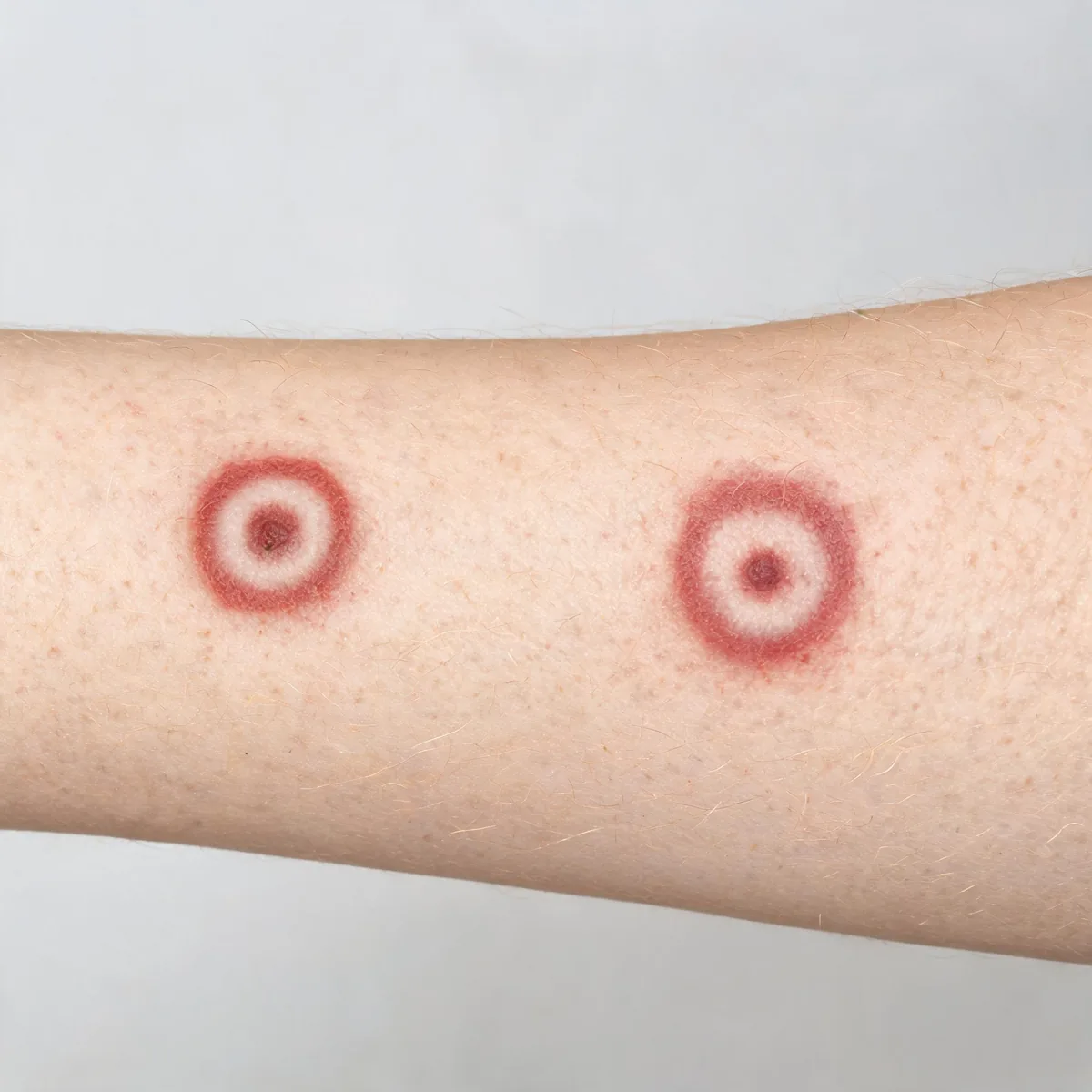
Which type is yours?
The traditional name means cat-eye sore, from the target-like rings of this eruption. Some cases are an infection reaction; widespread blistering or skin peeling is a medical emergency.
Wind-Heat
Bright red target lesions with fever and itchy burning.
Looks like: Bright red round target-like lesions; Red dry eyes
Read about this typeDamp-Heat
Weeping target lesions with yellow crusts and a heavy body.
Looks like: Lesions ooze clear to yellow fluid and form yellow crusts
Read about this typeWind-Cold
Dark purplish target lesions with cold hands and strong chills.
Looks like: Dark red or purplish target lesions
Read about this typeToxic-Heat
The severe picture: high fever with widespread bullae.
Looks like: Widespread large bullae with red swollen painful lesions
Read about this typeNot sure which? Take the Pattern check
Compare the typesWhere the spots sit, what they look like, the tongue and the main formula
Four patterns are described for erythema multiforme because the same target-shaped lesion can come from opposite conditions. Wind-Heat is the commonest and the most acute: it arrives after a sore throat or a cold, the lesions are bright, hot and itchy, and the person has a fever and thirst. Damp-Heat is slower and heavier: the lesions weep and crust, the body feels weighted and the mouth tastes sticky. Wind-Cold is the reverse of hot and bright, with dark purplish lesions that are cold when touched, cold hands and feet and strong chills without thirst. Toxic-Heat is a different order of illness, with large bullae, high fever and restlessness, and it is a medical emergency rather than something to treat at home. Colour, moisture and sensation are the first clues, and the tongue and pulse confirm which of the four is in front of the practitioner.
| Pattern | Key signs | The itch | Tongue |
|---|---|---|---|
| Wind-Heat | Bright red round target-like lesions; Red dry eyes | Intense itching and burning | Body: Red at the tip and edgesCoat: Thin yellow or white turning yellow |
| Damp-Heat | Lesions ooze clear to yellow fluid and form yellow crusts | Skin hot and itchy rather than just burning | Body: Red, often swollen with teeth marksCoat: Yellow, greasy and thick, usually in the middle and at the root |
| Wind-Cold | Dark red or purplish target lesions | Not specified | Body: Normal or slightly paleCoat: Thin white and moist |
| Toxic-Heat | Widespread large bullae with red swollen painful lesions | Not specified | Body: Red, often with raised red pointsCoat: Yellow, dry, sometimes thick |
Wind-HeatBright red target lesions with fever and itchy burning.
Avoid in pregnancy Caution in pregnancy
Bright red target lesions with fever and itchy burning.
Wind-Heat arrives from outside, most often on the back of a sore throat or a cold, and settles in the superficial layer of the skin where defensive Qi meets it. The two push against each other, and that friction shows as raised, round lesions with a darker centre and a red rim. Heat accounts for the brightness, the burning and the thirst; Wind accounts for the speed and for the way the rash can move from one area to another.
The tongue has a red tip and red edges, and its coat is thin and yellow, or white at first and turning yellow; the pulse floats and runs fast. Spicy food, hot showers, wind and sun, stress and rich meals all make it flare, while cool compresses, rest and chrysanthemum or peppermint tea calm it. Xiao Feng San is the formula used to dispel the wind, clear the heat and stop the itch, and the points are LI-4 (Hegu), LI-11 (Quchi), SP-10 (Xuehai) and LR-3 (Taichong).
Signs
- Bright red round target-like lesions
- Intense itching and burning
- Fever and sore throat
- Thirst for cold drinks
- Red dry eyes
Diet and lifestyle for this pattern: Eat cooling, light food such as mung bean soup, cucumber and chrysanthemum tea. Avoid spicy, greasy and fried food and seafood, which can fuel Heat, stay out of strong wind and direct sun while the rash is active, and rest so the body can fight the pathogen.
Damp-HeatWeeping target lesions with yellow crusts and a heavy body.
Avoid in pregnancy Caution in pregnancy
Weeping target lesions with yellow crusts and a heavy body.
Here the trigger is not only what comes from outside but what has been brewing inside. When fluids are not transformed properly, dampness accumulates, and once heat is added the mixture becomes heavy and sticky: it steams up and out, blocks the pores and makes the lesions weep a clear or yellow fluid that dries into crusts. Dampness also weighs the body down, so the head feels wrapped and the limbs heavy, while the taste in the mouth is sticky or bitter and the stools come loose and incomplete.
The tongue body is red with a yellow greasy coat that is thickest in the middle and at the root, and the pulse is soggy and rapid or slippery and rapid. Greasy, sweet and spicy food, alcohol, humid weather and long stretches of sitting all worsen it, while dry air, light cooling food and gentle movement help the body drain. Long Dan Xie Gan Tang drains the fire and clears the damp-heat, and the points are LI-4 (Hegu), ST-36 (Zusanli), SP-6 (Sanyinjiao) and GB-34 (Yanglingquan).
Signs
- Lesions ooze clear to yellow fluid and form yellow crusts
- Skin hot and itchy rather than just burning
- Body feels heavy
- Greasy taste
Diet and lifestyle for this pattern: Eat cooling, Dampness-draining food such as mung beans, barley, cucumber and lightly cooked leafy greens, and avoid all greasy, fried, sugary and dairy-heavy food that creates more Dampness. Keep the skin clean and dry, wear breathable fabrics, and walk or stretch gently to move Qi and dry internal Dampness.
Wind-ColdDark purplish target lesions with cold hands and strong chills.
Avoid in pregnancy Caution in pregnancy
Dark purplish target lesions with cold hands and strong chills.
When defensive Qi is weak and cold weather catches the body unprepared, Wind-Cold enters the superficial channels and stays there. Cold contracts, so Qi and Blood that should be moving freely become stuck, and the skin over the stuck area turns dark red or purplish. The lesions are still target-like but dull rather than bright, and they feel cold when touched. The cold also reaches the hands and feet, which stay chilly, and the whole body feels achy.
The tongue is normal or a little pale with a thin white moist coat, and the pulse floats and feels tight, like a wire under the finger. Cold weather, draughts, damp chilly rooms and raw or iced food bring it on, while warmth, covering up, ginger or cinnamon tea and a warm room ease it; chills are strong and fever is mild, and there is no thirst or a preference for warm drinks. Dang Gui Si Ni Tang warms the channels, disperses cold and moves Blood, and the points are LI-4 (Hegu), SJ-5 (Waiguan) and ST-36 (Zusanli).
Signs
- Dark red or purplish target lesions
- Cold hands and feet
- Worse in cold weather or after cold exposure
- Strong chills with mild fever
Diet and lifestyle for this pattern: Keep the body warm, especially the hands and feet, wear layers and keep out of draughts, and sip warm ginger and cinnamon tea daily to warm the interior gently. Avoid raw, cold food and iced drinks that worsen stagnation, and walk gently to keep Qi moving without strain.
Toxic-HeatThe severe picture: high fever with widespread bullae.
Avoid in pregnancy Caution in pregnancy
The severe picture: high fever with widespread bullae.
Toxic-Heat is the severest form and the one that needs the quickest decision. Heat toxins have gone past the surface and into the Blood level, where they scorch the skin and drive out large blisters and bullae on fiery red, swollen and painful skin. The whole body is involved: high fever, a thirst that cold drinks do not really settle, restlessness and irritability as the heat unsettles the mind, and scanty dark urine or constipation while the fluids dry up.
The tongue is red and covered in prickly thorns under a dry yellow coat, and the pulse runs fast and forceful, often slippery. Spicy food, alcohol, sun exposure and stress add fuel, and only cooling food, a cool room and rest help. Qing Wen Bai Du Yin is the formula chosen first for fire-toxin at its height, clearing heat, cooling the Blood and resolving toxicity, with Huang Lian Jie Du Tang for toxicity that is prominent while the fever is less extreme; the points are DU-14 (Dazhui), LI-11 (Quchi) and SP-10 (Xuehai). A picture like this belongs in hospital care, not in a home prescription.
Signs
- High fever
- Widespread large bullae with red swollen painful lesions
- Thirst for cold drinks
- Restlessness and irritability
Diet and lifestyle for this pattern: Avoid spicy, greasy and fried food, alcohol and coffee, all of which add Heat. Drink plenty of cool water and eat cooling food such as cucumber, watermelon and mung beans, rest in a cool quiet room, and stay out of the sun until the acute phase passes.
What you can do
Start with the daily measures that match your type. Herbs and formulas come after these, and only with a practitioner.
- Wind-Heat: Eat cooling, light food such as mung bean soup, cucumber and chrysanthemum tea. Avoid spicy, greasy and fried food and seafood, which can fuel Heat, stay out of strong wind and direct sun while the rash is active, and rest so the body can fight the pathogen.
- Damp-Heat: Eat cooling, Dampness-draining food such as mung beans, barley, cucumber and lightly cooked leafy greens, and avoid all greasy, fried, sugary and dairy-heavy food that creates more Dampness. Keep the skin clean and dry, wear breathable fabrics, and walk or stretch gently to move Qi and dry internal Dampness.
- Wind-Cold: Keep the body warm, especially the hands and feet, wear layers and keep out of draughts, and sip warm ginger and cinnamon tea daily to warm the interior gently. Avoid raw, cold food and iced drinks that worsen stagnation, and walk gently to keep Qi moving without strain.
- Toxic-Heat: Avoid spicy, greasy and fried food, alcohol and coffee, all of which add Heat. Drink plenty of cool water and eat cooling food such as cucumber, watermelon and mung beans, rest in a cool quiet room, and stay out of the sun until the acute phase passes.
Everyday habitsDiet and routine advice for every type
- Avoid spicy, greasy and fried food while lesions are active, and keep fluids up.
- The general rule is to eat in a way that neither feeds heat nor adds dampness: plenty of vegetables, cucumber, celery, leafy greens and mung beans, chrysanthemum or peppermint tea, and very little fried, greasy, sugary or spicy food, alcohol or coffee. The pattern changes the emphasis. Wind-Heat does better on cooling foods and away from hot showers and alcohol, Damp-Heat needs light meals with less sugar and dairy, Wind-Cold benefits from warm cooked food, ginger and cinnamon and should avoid raw or iced food, and Toxic-Heat needs cooling food and plenty of fluids. Whatever the pattern, known food allergens should be avoided while the skin is reacting.
Beauty practices:
What a practitioner might use
Herbs are prescribed to the pattern by a qualified practitioner. Do not self-prescribe.
Avoid in pregnancy Caution in pregnancy
Acupoints 9
Formulas 5
Herbs 11
- Jing Jie 荆芥Caution in pregnancy
- Fang Feng 防风Caution in pregnancy
- Niu Bang Zi 牛蒡子Caution in pregnancy
- Long Dan Cao 龙胆草Avoid in pregnancy
- Huang Qin 黄芩
- Ku Shen 苦参Caution in pregnancy
- Fu Ling 茯苓
- Dang Gui 当归Caution in pregnancy
- Gui Zhi 桂枝Caution in pregnancy
- Huang Lian 黄连Caution in pregnancy
- Jin Yin Hua 金银花Caution in pregnancy
What each one is used for is in the notes below.
Herbs, formulas and acupointsPrinciples, the herbs and points used, and what to expect
Avoid in pregnancy Caution in pregnancy
How the tradition treats erythema multiforme, with the herbs, formulas and points used for it.
Principles
- Assess for a severe drug reaction first: widespread blistering and mucosal sores are an emergency.
- Clear Wind-Heat where lesions are target-like with fever.
- Drain dampness where lesions weep and crust.
- Warm and dispel cold where lesions are dark with coldness, and clear toxicity in the severe pattern.
- The logic underneath these choices is that the lesion tells you where the pathogen is sitting. A bright, fast, itchy eruption calls for dispersing wind and cooling heat; an oozing, heavy one calls for drying dampness and draining the channel that feeds it; a dark, cold one calls for warming and moving Blood; a blistering, feverish one calls for clearing toxin at depth. Herbs do the internal work, acupuncture supports them, and the aim in every case is to shorten the episode and leave the body less reactive to the next trigger.
Herbs used
Formulas
Acupoints
- LI-4 (Hegu)Avoid in pregnancy
- LI-11 (Quchi)
- SP-10 (Xuehai)
- LR-3 (Taichong)
- ST-36 (Zusanli)
- SP-6 (Sanyinjiao)Avoid in pregnancy
- GB-34 (Yanglingquan)
- SJ-5 (Waiguan)
- DU-14 (Dazhui)
What to expect
- Mild infection-triggered cases are described as settling over one to three weeks.
- Recurrence is possible, especially with herpes simplex triggers.
- Severe reactions need hospital care and can be life-threatening.
- Most people see the rash begin to fade and the itch settle within one to three weeks, though a damp-heat picture can be slower because dampness clears gradually. Acupuncture is usually weekly or twice weekly while the skin is active, then spaced out as it settles, and the formula is changed as the pattern changes rather than kept the same for months. Recurrent cases often need a longer constitutional course, with herbs taken daily for two to three months, to reduce how readily the skin reacts.
Formulas often used
Safety and when to see a doctor
Seek medical help urgently for
- Widespread blistering or skin detachment.
- Sores in the mouth, eyes or genitals.
- High fever with rapidly spreading lesions, or a reaction after starting a new medication.
Avoid in pregnancy
Some herbs and points named on this page carry pregnancy warnings. They are marked where they appear, and each links to its own safety notes.
Cautions
- Any new medication should be reviewed as a trigger.
- Do not continue a suspected trigger drug without advice.
- Mucosal involvement needs immediate medical assessment.
Using this alongside conventional care
- This page is complementary: a suspected severe reaction needs emergency care, and herbs are only used in mild cases with medical agreement.
- There is no reason to choose between the two approaches in a mild case. Topical steroids, antihistamines and antivirals are not known to interact with the herbs used here, and the two can run alongside each other; where systemic corticosteroids are being used, herbs may support a gradual taper, but only with the prescribing doctor involved. Bring a full medication list to the consultation and tell the doctor what is being taken. Two cautions are worth stating plainly: a severe reaction with blistering or mucosal involvement needs emergency care rather than a herbal prescription, and no prescribed medicine should be stopped without medical advice.
If you're pregnant
Pregnancy sends Qi and Blood toward the fetus, which leaves the surface more open to outside pathogens, and the eruption is most often read at this time as Wind-Heat or Damp-Heat. The difficulty is medication. Herbs that clear heat and dry dampness are often too cold or too dispersing now: Long Dan Xie Gan Tang, with Long Dan Cao and Huang Qin at its core, is generally left out, and Xiao Feng San, though considered safer, is modified by keeping Fang Feng and Jing Jie in small doses or dropping Chan Tui.
Acupuncture is often the first choice, using points such as LI-4 (Hegu) and LI-11 (Quchi) with gentle stimulation, and treatment should sit with a practitioner who works with pregnant patients. Any severe reaction with blistering or mucosal involvement needs urgent medical assessment whatever the stage of pregnancy.
If you're breastfeeding
Bitter-cold herbs that clear damp-heat can find their way into milk and may cause diarrhoea or digestive upset in a nursing infant; Huang Lian and Huang Qin are the strongest of them, and Long Dan Cao belongs in the same group, so strong formulas such as Long Dan Xie Gan Tang are generally avoided while feeding. Gentler herbs that drain dampness without much cold, among them Fu Ling and Yi Yi Ren, suit the Spleen deficiency picture without that risk, and external treatment remains a traditional option, although trial evidence is limited.
Acupuncture carries no risk to the baby and remains a good option. Where herbs are needed, the dose is kept lower and the infant is watched for changes in stool or behaviour.
If treating a child
In children the trigger is usually a recent cold or sore throat, which makes Wind-Heat the commonest pattern, though an immature digestion means damp-heat can also build from unsuitable food. Diagnosis leans on observation: a red tongue tip with a yellow coat and a floating rapid pulse are the usual findings, and doses are reduced to a third or a half of the adult dose according to age and weight.
Xiao Feng San is often used, with the bitter herbs kept to a minimum so the Spleen is not damaged, and needles are usually replaced with gentle acupressure or paediatric tui na on LI-4 (Hegu) and LI-11 (Quchi). Caregivers are asked about diet, bowels and sleep, since a child's account of the rash is limited.
If treating an elderly patient
Older patients often arrive with an underlying deficiency, most commonly of Qi and Blood, which is why the skin reacts to pathogens it would once have shrugged off. The Toxic-Heat pattern is the one to watch, because a constitution that is already depleted may not tolerate strong clearing, and cold formulas such as Qing Wen Bai Du Yin are avoided unless there is no alternative.
Doses are usually about two thirds of the adult dose and tonics such as Dang Gui and Huang Qi are included to support resistance, watching for any digestive upset. In this age group acupuncture is generally well tolerated, and ST-36 (Zusanli) is often added to support the Spleen and Stomach. Treatment takes longer, and the emphasis shifts toward building resilience so that recurrences become less likely.
Urgent-sign guidance is based on standard sources: NHS anaphylaxis, NHS cellulitis, NHS Stevens-Johnson syndrome, NHS melanoma.
Avoid in pregnancy
For anything severe, sudden or spreading quickly, read when a skin problem needs urgent care.
Understanding
The tradition describes erythema multiforme through defensive Qi protecting the skin surface. When that defence is weakened by overwork or illness and a pathogen invades, the target lesions appear.
Wind-Heat gives bright red round target-like lesions with intense itching and burning, fever, sore throat, thirst and red dry eyes. That is the commonest pattern.
Read more about how Erythema multiforme is understood
Damp-Heat gives lesions that ooze or weep clear to yellow fluid and form yellow crusts, with skin that feels hot and itchy rather than burning, a heavy body and a greasy taste.
Wind-Cold gives dark red or purplish target lesions with cold hands and feet, worse in cold weather and after cold exposure, with strong chills and mild fever. Toxic-Heat is the severe pattern: high fever with widespread large bullae, red swollen painful lesions, intense thirst and restlessness. The classical literature treats that as dangerous, and so does conventional medicine.
The mechanism is a collision at the surface. Defensive Qi circulates just beneath the skin and keeps pathogens out; when overwork, poor diet, worry or a recent illness has weakened it, Wind, Heat, Cold or Dampness may get through and provoke a visible reaction, and the target-like lesions are the mark of that contest.
What the practitioner reads first is not the diagnosis but the quality of the rash: whether the rings are bright or dark, dry or weeping, hot or cold when touched. Those impressions, checked against tongue and pulse, decide which pathogen dominates, and therefore which formula and points are chosen.
How it connects
Erythema multiforme often appears shortly after an upper respiratory infection, particularly acute pharyngitis or tonsillitis. In TCM the same external pathogen, usually Wind-Heat, first attacks the throat and causes soreness and fever, then spreads outward to the skin; the skin is the body's first line of defence, and once Lung and defensive Qi are weakened by the throat infection, the pathogen moves to the surface and produces the target-like rash. Treating throat and skin together with formulas that clear Wind-Heat and resolve toxicity often brings relief to both at once. The general principle behind the pairing is that TCM groups conditions by pattern rather than by organ, so a throat infection and a skin eruption can belong to the same story. Clearing the shared pattern is expected to help both, which is why treatment here is chosen for the pattern rather than for the rash alone, and why a practitioner asks about recent sore throats, colds and medicines before writing a prescription.
The conventional viewHow conventional medicine describes and treats Erythema multiforme
Erythema multiforme is an acute reaction mounted by the immune system, recognised by the ring-shaped or bull's-eye lesions which favour the hands and feet, the arms and the legs. It usually follows an infection, most often herpes simplex, or a medicine such as an antibiotic or an NSAID. The rash comes up quickly and may itch or burn, and more severe attacks add blisters and ulcers in the mouth. The diagnosis is clinical: the look of the lesions plus the history of a recent infection or of a newly started medicine.
Mild attacks are managed symptomatically: antihistamines for the itch, topical corticosteroids to calm inflammation, cool compresses, and an oral antiviral where herpes simplex is the trigger and recurrences are a problem. Severe or widespread disease, especially with mucous membrane involvement, may need systemic corticosteroids for a short period, or supportive care in hospital while the reaction runs its course.
The limitation is that this controls the episode without altering the tendency behind it. Recurrences are common where a chronic infection such as herpes is the trigger, long-term steroid use carries its own risks, and the treatment is the same whether the eruption is bright, hot and thirst-making or dark, cold and oozing. The distinctions that decide a Chinese medicine prescription are not part of the conventional assessment.
Selected PubMed records
Real PubMed records for the conventional discussion above, selected by condition name and title relevance. They are references, not a claim that any treatment is proven for this condition.
- Erythema Multiforme: Recognition and Management.. American family physician, 2019. PMID: 31305041.
- Erythema multiforme.. EClinicalMedicine, 2024. PMID: 39583748.
How it is assessed
The practitioner assesses lesion type, mucosal involvement and the trigger.
What a practitioner looks for
What a practitioner looks for
- Lesions: target rings suggest Wind-Heat; oozing lesions suggest Damp-Heat; dark lesions with coldness suggest Wind-Cold.
- Severity: widespread bullae, high fever or mucosal involvement indicates a severe reaction.
- Trigger: recent infection or new medication is the key question.
- Red flags: blistering, skin peeling, or sores in the mouth or eyes.
The practitioner begins with the lesions themselves. Bright red rings that appeared suddenly, hot and itchy, with a red tongue and thin yellow coat and a floating rapid pulse, point to Wind-Heat, which often follows wind exposure or a change in weather and comes with a mild fever or sore throat. Lesions that weep and crust, with a thick greasy yellow coat and a slippery rapid pulse, point instead to Damp-Heat, and tend to come with a heavy body and a poor appetite.
A darker picture is worth knowing. Purple or dark red lesions that are cold when touched, with cold hands and feet, a slightly pale tongue under a thin white moist coat and a tight floating pulse, suggest Wind-Cold obstructing the channels, and joint pain with a dislike of cold is a common clue. Widespread blisters with high fever, intense thirst, a deep red tongue under a thick yellow coat and a forceful rapid pulse mean Toxic-Heat blazing, which needs immediate professional care.
Evidence
Evidence status
Modern research is summarised below. It has not yet been assessed for quality by a clinical reviewer, so treat it as a pointer to sources, not proof of effect.
Small Chinese trials have been reported; their quality has not been assessed.
PubMed records for the TCM evidence
Real PubMed records for the TCM clinical evidence discussed above, selected by condition name and title relevance. They are references, not proof of benefit.
- Sintilimab-induced erythema multiforme drug eruption in the treatment of sigmoid colon cancer: A case report and literature review.. Medicine, 2023. PMID: 37832081.
- [Observation on therapeutic effect of He's Santong needling methods on cold erythema multiforme].. Zhongguo zhen jiu = Chinese acupuncture & moxibustion, 2009. PMID: 19873917.
Common questions
Is erythema multiforme serious?
Mild cases settle, but widespread blistering or mucosal involvement suggests a severe drug reaction and is an emergency.
What triggers it?
Infections, especially herpes simplex, and medications are common triggers.
Can it recur?
Yes, particularly when herpes simplex is the trigger.
When should I go to hospital?
Blistering, skin peeling, mucosal sores, or high fever with rapid spread.
Can acupuncture help the rash?
Yes, as a support rather than the main treatment. Points such as LI-4 (Hegu) and LI-11 (Quchi) expel wind and clear heat from the skin, and SP-10 (Xuehai) cools the blood, which eases itching and calms redness. For the eruption itself the main treatment is usually herbal, with acupuncture alongside it to speed recovery and address the underlying imbalance.
How long does herbal treatment take to work?
The answer depends on the pattern. Where Wind-Heat or Wind-Cold is responsible, the rash often begins to settle within a week and the itching eases, while a Damp-Heat picture usually takes three to four weeks because dampness clears slowly. If a chronic trigger such as herpes simplex is involved, a course of two to three months is common, aiming at fewer and milder episodes rather than a quick fix.
Do I need to change my diet?
Diet matters. Spicy, greasy and very sweet food creates dampness and heat, and alcohol and coffee aggravate heat patterns, so they are reduced while the skin is active. Cooling foods suit most patterns: cucumber, mung beans, plenty of vegetables and chrysanthemum tea, while a Wind-Cold picture does better with warm cooked food and ginger. Your practitioner will tailor this to your pattern.