
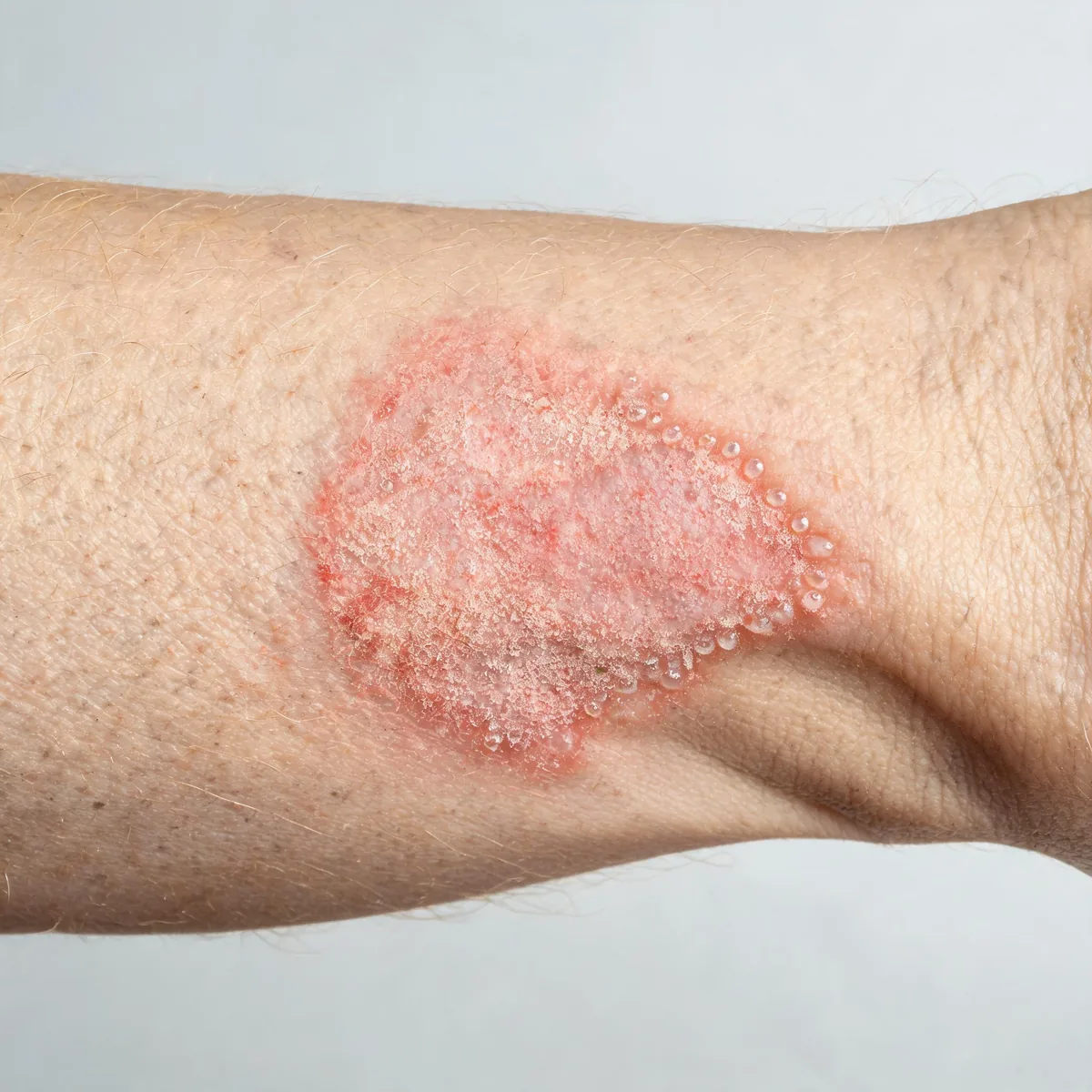
Which type is yours?
Eczema is not one thing in Chinese medicine. Its appearance - red and weeping, or dry and thickened - is read as the signature of a particular internal imbalance, and the treatment follows that signature rather than the rash alone.
Damp-Heat invading the Spleen
湿热蕴脾
Looks like: Red oozing papules and vesicles; Heavy, tired limbs
Read about this typeSpleen Deficiency with Dampness
脾虚湿蕴
Looks like: Dull, darker lesions with mild oozing or scaling
Read about this typeKidney and Liver Yin Deficiency
肝肾阴虚
Looks like: Dry thin skin with fine scaling; Dizziness, tinnitus, blurred vision
Read about this typeNot sure which? Take the Pattern check
Compare the typesWhere the spots sit, what they look like, the tongue and the main formula
Eczema is not one pattern. In TCM the same diagnosis can arise from several different internal imbalances, and the aim is to identify which one is driving the skin at that moment rather than to treat the label. The five patterns described here separate an acute, hot, weeping picture from a chronic, dry, deficient one, and they can overlap: a person may carry a dry underlying pattern with a hot acute flare on top. Each pattern has its own rationale, its own tongue and pulse, and its own herbal and acupuncture strategy, which is why what helps one person's eczema can aggravate another. The self-check above is a way into that differentiation, not a diagnosis; a practitioner confirms it from the history, the skin, the tongue and the pulse.
| Pattern | Key signs | The itch | Tongue | Main formula |
|---|---|---|---|---|
| Damp-Heat invading the Spleen | Red oozing papules and vesicles; Heavy, tired limbs | Intense itch, worse with heat and humidity | Body: Red, often swollen with teeth marksCoat: Thick, yellow and greasy at the centre and root | Long Dan Xie Gan Tang |
| Spleen Deficiency with Dampness | Dull, darker lesions with mild oozing or scaling | Not specified | Body: Pale and swollen, often with teeth marks along the edgesCoat: White, greasy and moist, thick in the middle | Shen Ling Bai Zhu San |
| Blood Deficiency with External Wind | Dry, scaly, thickened skin | Itch that comes and goes or moves | Body: Pale and thin, sometimes slightly dryCoat: Thin, white and a little dry | Dang Gui Yin Zi |
| Wind-Heat | Sudden outbreak of red papules; Burning skin | Intense itch | Body: Red at the tip and edgesCoat: Thin yellow or white turning yellow | Xiao Feng San |
| Kidney and Liver Yin Deficiency | Dry thin skin with fine scaling; Dizziness, tinnitus, blurred vision | Itch worse at night | Body: Red, thin and dry, often crackedCoat: Little or none; the tongue may look peeled | Liu Wei Di Huang Wan |
Damp-Heat invading the Spleen湿热蕴脾
Avoid in pregnancy Caution in pregnancy
湿热蕴脾
The acute, weeping stage - red, oozing and hot, often with digestive heaviness.
This is the classic acute, weeping picture. The Spleen is described as transforming and transporting fluids; when rich greasy food, alcohol, heat or a humid climate overload it, Damp-Heat accumulates inside and spills out into the skin as red, oozing papules and vesicles with intense itch that worsens in heat and humidity. The digestive signs belong to the same picture rather than to a separate problem: fullness and stuffiness in the upper abdomen, a sticky taste, loose sticky stools, and a heavy dragged-down feeling are the Spleen signalling that the root is digestive.
The tongue is red with a yellow greasy coating, thickest at the centre and root, and may be swollen with teeth marks, while the pulse is soggy and rapid or slippery and rapid. Spicy, greasy and sweet food, alcohol, hot humid weather and stress aggravate it; a light bland diet, a cool dry environment, rest and cool compresses ease it. Treatment clears Heat and drains Dampness, with Long Dan Xie Gan Tang as the standard formula, supported by points such as LI-11 and SP-10 to cool the Blood and relieve itch.
Signs
- Red oozing papules and vesicles
- Intense itch, worse with heat and humidity
- Upper abdominal stuffiness
- Sticky or loose stools
- Heavy, tired limbs
Diet and lifestyle for this pattern: Eat light, easy food such as congee, barley and mung beans, and avoid greasy, fried, spicy and sweet food as well as alcohol and dairy, which create Dampness and Heat. Keep the skin cool and dry, avoid hot showers and heavy sweating, and walk gently rather than overexerting.
Spleen Deficiency with Dampness脾虚湿蕴
Avoid in pregnancy Caution in pregnancy
脾虚湿蕴
Duller, less angry lesions with fatigue and a digestive picture - deficiency with dampness rather than heat.
Here the Spleen is weak rather than overloaded. It cannot move fluids efficiently, so they pool as Dampness and seep into the skin, giving dull, darkish patches with mild oozing or scaling that are slow to dry, alongside fatigue, poor appetite, bloating after eating, loose stools and thirst without real desire to drink.
The tongue is pale and puffy with scalloped edges and a white greasy coating, and the pulse soggy and slightly slow. Cold raw food, greasy meals, humid weather, overwork and prolonged sitting make it worse, while warmth, small warm meals, gentle exercise and sleep help. Treatment strengthens the Spleen and drains Dampness, with Shen Ling Bai Zhu San as the standard, supported by points such as ST-36, SP-6, SP-9 and BL-20.
Signs
- Dull, darker lesions with mild oozing or scaling
- Fatigue and heaviness
- Poor appetite and bloating
- Loose stools
- Thirst without wanting to drink
Diet and lifestyle for this pattern: Eat warm cooked food such as soups, stews and congee, and avoid cold, raw, greasy and dairy-heavy meals that create more Dampness. Gentle daily walking helps the Spleen move fluids, and keep the skin clean and dry without harsh soap that strips its oils.
Blood Deficiency with External Wind血虚风燥
Avoid in pregnancy Caution in pregnancy
血虚风燥
The chronic, dry, thickened picture with itch that moves and worsens at night.
This is the chronic dry picture. Long-standing Damp-Heat is said to consume Blood and Yin, so the skin loses its nourishment and becomes dry, rough, scaly and thickened. That emptiness lets external Wind invade, producing an itch that moves around and worsens at night, when Blood is quieter.
The tongue is pale and thin with a thin white, slightly dry coating, and the pulse fine, wiry at the left middle position and floating at the right front. Windy dry weather, stress and overwork, spicy or fried food and lack of sleep aggravate it; moisturising, a warm non-drying environment, adequate sleep and nourishing soups help. Treatment nourishes Blood, moistens dryness and dispels Wind, with Dang Gui Yin Zi as the standard formula and points such as SP-10, ST-36 and SP-6.
Signs
- Dry, scaly, thickened skin
- Itch that comes and goes or moves
- Itch worse at night
- Aversion to wind and drafts
- Pale or dull complexion
- Dizziness or light-headedness
Diet and lifestyle for this pattern: Eat blood-nourishing food such as dark leafy greens, liver, red dates, goji berries and black sesame. Keep the skin well moisturised with a gentle fragrance-free emollient, avoid long exposure to wind and draughts, and get restful sleep to support Blood regeneration.
Wind-Heat风热
Avoid in pregnancy Caution in pregnancy
风热
Sudden, burning, itchy red papules, often with a sore throat or a feverish feeling.
This pattern begins with an external invasion. Wind is light and mobile, so it opens the pores and carries Heat into the skin, producing a sudden crop of red papules with burning and fierce itch. Because the attack is still at the surface, there may be mild fever and chills, a sore red throat, thirst and a floating rapid pulse.
The tongue tip and edges are red with a thin yellow coating, and the pulse floating and rapid. Spicy or fried food, windy hot weather, hot showers and stress worsen it, while cool compresses, rest and a light diet ease it. Treatment dispels Wind and clears Heat, using Xiao Feng San as the standard formula, with points such as LI-11, LI-4, SP-10 and DU-14.
Signs
- Sudden outbreak of red papules
- Burning skin
- Intense itch
- Sore red throat
- Thirst
- Fever with mild chills
Diet and lifestyle for this pattern: Avoid spicy, greasy and fried food that adds Heat, and stay away from alcohol and coffee. Keep the skin cool and dry, an oatmeal bath can soothe irritation, protect yourself from wind and sudden temperature change, and resist scratching to prevent secondary damage.
Kidney and Liver Yin Deficiency肝肾阴虚
Avoid in pregnancy Caution in pregnancy
肝肾阴虚
Dry, thin skin with night-time itch, low-back weakness and other signs of depleted Yin.
Kidney and Liver Yin are the body's deep cooling and moistening reserves. When they run low, deficiency Heat flares and dries the skin, producing chronic thin dry skin with fine scaling or mild redness and itch that worsens at night. It is especially common in older adults, whose Yin declines with age, and the deeper signs, night sweats with heat in palms and soles, sore lower back and knees, dizziness, tinnitus and dry mouth, reveal the root.
The tongue is red and thin with cracks and little or no coating, and the pulse fine, rapid and wiry. Overwork and late nights, spicy fried or drying food, dry heated air and stress aggravate it; sleep, a cool humidified environment, Yin-nourishing food and gentle exercise help. Treatment nourishes Kidney and Liver Yin with Liu Wei Di Huang Wan, supported by points such as KI-3, BL-23, BL-18 and SP-6.
Signs
- Dry thin skin with fine scaling
- Itch worse at night
- Sore, weak lower back and knees
- Dizziness, tinnitus, blurred vision
- Night sweats, heat in palms and soles
Diet and lifestyle for this pattern: Put rest first and avoid late nights, since sleep rebuilds Yin. Eat moistening food such as pear, black sesame, tofu and goji berries, avoid spicy, fried and very dry food, keep the skin hydrated with fragrance-free moisturiser, and use calming practice such as tai chi or meditation to conserve Yin.
What you can do
Start with the daily measures that match your type. Herbs and formulas come after these, and only with a practitioner.
- Damp-Heat invading the Spleen: Eat light, easy food such as congee, barley and mung beans, and avoid greasy, fried, spicy and sweet food as well as alcohol and dairy, which create Dampness and Heat. Keep the skin cool and dry, avoid hot showers and heavy sweating, and walk gently rather than overexerting.
- Spleen Deficiency with Dampness: Eat warm cooked food such as soups, stews and congee, and avoid cold, raw, greasy and dairy-heavy meals that create more Dampness. Gentle daily walking helps the Spleen move fluids, and keep the skin clean and dry without harsh soap that strips its oils.
- Blood Deficiency with External Wind: Eat blood-nourishing food such as dark leafy greens, liver, red dates, goji berries and black sesame. Keep the skin well moisturised with a gentle fragrance-free emollient, avoid long exposure to wind and draughts, and get restful sleep to support Blood regeneration.
- Wind-Heat: Avoid spicy, greasy and fried food that adds Heat, and stay away from alcohol and coffee. Keep the skin cool and dry, an oatmeal bath can soothe irritation, protect yourself from wind and sudden temperature change, and resist scratching to prevent secondary damage.
- Kidney and Liver Yin Deficiency: Put rest first and avoid late nights, since sleep rebuilds Yin. Eat moistening food such as pear, black sesame, tofu and goji berries, avoid spicy, fried and very dry food, keep the skin hydrated with fragrance-free moisturiser, and use calming practice such as tai chi or meditation to conserve Yin.
Everyday habitsDiet and routine advice for every type
- Across the patterns the advice converges: limit greasy, fried and spicy food, alcohol, dairy and refined sugar, since these are the foods the framework regards as generating dampness and heat. Individual triggers vary, and a food-and-symptom diary is more useful than a universal list.
- For the dry chronic pattern, add moistening foods such as pear, black sesame, tofu and congee, and keep meals warm and cooked. For the acute weeping pattern, cooling foods such as mung beans, cucumber and watermelon can be used while greasy, fried and spicy food, alcohol, dairy and refined sugar are reduced. Regular meal times and not overeating support the Spleen, which is central to managing eczema.
Beauty practices:
What a practitioner might use
Herbs are prescribed to the pattern by a qualified practitioner. Do not self-prescribe.
Avoid in pregnancy Caution in pregnancy
Acupoints 11
Formulas 5
Herbs 15
- Long Dan Cao 龙胆草Avoid in pregnancy
- Huang Qin 黄芩
- Ze Xie 泽泻Caution in pregnancy
- Cang Zhu 苍术Caution in pregnancy
- Bai Zhu 白术
- Fu Ling 茯苓
- Yi Yi Ren 薏苡仁Caution in pregnancy
- Dang Gui 当归Caution in pregnancy
- He Shou Wu 何首乌Caution in pregnancy
- Fang Feng 防风Caution in pregnancy
- Ku Shen 苦参Caution in pregnancy
- Shu Di Huang 熟地黄Caution in pregnancy
- Gou Qi Zi 枸杞子
- Mo Han Lian 墨旱莲Caution in pregnancy
- Nu Zhen Zi 女贞子Caution in pregnancy
What each one is used for is in the notes below.
Herbs, formulas and acupointsPrinciples, the herbs and points used, and what to expect
Avoid in pregnancy Caution in pregnancy
How the tradition treats eczema, with the herbs, formulas and points used for it.
Principles
- Treat the root and the branch together: clear the acute skin picture while addressing the internal imbalance that keeps producing it.
- In the acute, weeping stage, clear heat and drain dampness; in the chronic, dry stage, nourish Blood and Yin and settle Wind.
- Respect the stage. What helps an oozing, hot rash can aggravate dry, fragile skin, and vice versa.
- Support the Spleen throughout - the classical literature stresses that dampness will recur if digestion is not addressed.
- The acute weeping stage is treated as excess and requires clearing Heat and draining Dampness; the chronic dry stage is treated as deficiency and requires nourishing Blood and Yin. Most plans do both in proportion, addressing the branch during a flare and the root between flares.
Herbs used
Formulas
- Long Dan Xie Gan Tang - Formulas Long Dan Xie Gan Tang - Clears heat and drains dampness from the Liver and Gallbladder - the hot, weeping, angry picture.
- Shen Ling Bai Zhu San - Strengthens the Spleen and drains dampness - the duller, fatigue-linked pattern.
- Dang Gui Yin Zi - Nourishes Blood and dispels Wind - the dry, thickened, night-itch pattern.
- Xiao Feng San - Xiao Feng San - Dispels Wind, clears heat and addresses dampness - used across itchy, spreading rashes.
- Liu Wei Di Huang Wan - Nourishes Liver and Kidney Yin - the depleted, dry, chronic picture.
Acupoints
- LI-11 (Quchi) - Clears heat and cools the Blood; a first-line point for hot, itchy skin.
- SP-10 (Xuehai) - Cools the Blood and is used for heat in the skin - the 'sea of blood'.
- SP-9 (Yinlingquan) - Drains dampness, for oozing and swelling.
- ST-36 (Zusanli) - Strengthens the Spleen and Stomach, supporting the root of dampness.
- SP-6 (Sanyinjiao) - Nourishes Yin and Blood; also drains dampness.Avoid in pregnancy
- BL-20 (Pishu) - The Spleen's back-shu point, used to support digestion.
- LI-4 (Hegu) - Dispels Wind and relieves itch on the surface.Avoid in pregnancy
- DU-14 (Dazhui) - DU-14 (Dazhui) - Clears heat and releases the exterior.
- KI-3 (Taixi) - Nourishes Kidney Yin in the depleted picture.
- BL-23 (Shenshu) - The Kidney's back-shu point, supporting constitutional reserves.
- BL-18 (Ganshu) - The Liver's back-shu point, supporting the Blood-storing function.
What to expect
- A typical plan combines regular acupuncture with a daily herbal formula, taken as a decoction or concentrated powder.
- In the first weeks the aim is symptom control - less oozing, less redness, less itch.
- Chronic, dry eczema is expected to improve more slowly, with visible skin change over two to three months.
- Consistency matters more than intensity; the classical literature stresses that improvement is lost when treatment is stopped early.
- Expect fluctuations rather than a straight line: dietary slips and stress can cause short flares, and the trend over several weeks matters more than any single day. Once the skin is stable, many people move to a maintenance diet and occasional acupuncture to sustain the result.
Formulas often used
Safety and when to see a doctor
Seek medical help urgently for
- Signs of skin infection - increasing pain, swelling, warmth, red streaks or pus, especially with fever.
- A sudden widespread rash with fever or feeling unwell.
- Swelling of the face, lips or throat, or difficulty breathing - treat as an emergency.
- Blistering or peeling skin, or skin that is rapidly spreading.
Avoid in pregnancy
Some herbs and points named on this page carry pregnancy warnings. They are marked where they appear, and each links to its own safety notes.
Cautions
- Do not stop prescribed topical or systemic treatment abruptly; stopping corticosteroids abruptly can trigger a flare.
- Long-term use of internal herbal formulas should be supervised, with liver function checked where indicated - several herbs used in chronic skin formulas carry that caution on their own pages.
- Children, pregnancy and breastfeeding require practitioner review before internal herbs.
- Open, broken skin should not be treated with strong topical applications without advice.
Using this alongside conventional care
- TCM is described as complementary to conventional care: emollients and mild topical corticosteroids can be used alongside herbs and acupuncture. Where oral immunosuppressants or biologics are being taken, the combination should be discussed with the prescribing doctor rather than changed unilaterally.
- Topical moisturisers and mild corticosteroids can be used alongside herbs and acupuncture. If oral immunosuppressants such as ciclosporin, methotrexate or prednisone, or biologic drugs, are being taken, tell both the TCM practitioner and the prescribing doctor, because some herbs may interact with them or affect liver function. Prescribed medication should never be stopped suddenly, and a full medication list should be brought to the consultation.
If you're pregnant
During pregnancy Blood and Yin are directed towards nourishing the fetus, so Blood deficiency patterns can become more prominent, and the skin may turn drier and itchier, especially in the later months. Treatment leans towards gentle nourishment rather than strong cooling or moving methods.
Very bitter and cold herbs such as Long Dan Cao and Ku Shen are avoided in pregnancy, as is Dang Gui, and milder alternatives may be used instead. External washes with Huang Bai and Ku Shen are traditionally used, with limited trial evidence; a practitioner should be consulted, especially in pregnancy.
Acupuncture is often preferred to internal herbs. Points traditionally avoided in pregnancy, including Hegu (LI-4) and Sanyinjiao (SP-6), must not be used, and a licensed practitioner will choose safe points such as Quchi (LI-11) and Xuehai (SP-10) to relieve itching. Any treatment during pregnancy should be arranged with a practitioner experienced in obstetric care.
If you're breastfeeding
Bitter and cold herbs such as Long Dan Cao and Huang Qin can pass into breast milk and may cause loose stools or digestive upset in a nursing infant. For acute, weeping eczema in a breastfeeding mother, a bland diet, external herbal washes and acupuncture are the safer first line rather than strong internal decoctions.
If internal herbs are needed, a practitioner will choose mild, neutral herbs that support the Spleen and drain Dampness without coldness, such as Fu Ling and Bai Zhu. Nourishing formulas such as Dang Gui Yin Zi can be used with caution, since they do not usually affect milk supply or infant digestion.
Acupuncture is a drug-free option with no risk to the baby and can effectively reduce itching and inflammation. Dietary changes such as avoiding greasy, spicy and dairy-rich food often make a significant difference and support both mother and baby.
If treating a child
In children eczema is most often linked to an immature Spleen and a tendency to accumulate Dampness from food stagnation. A diet high in sweets, dairy and greasy snacks easily overwhelms the child's digestion, producing internal Damp-Heat that erupts on the skin, and the acute stage often shows as red, weepy patches on the cheeks and in the flexures, matching Wind-Heat or Damp-Heat.
Herbal doses are reduced according to age and weight, typically a quarter to a half of an adult dose. Xiao Feng San is a classic choice for acute, itchy, red eczema in children, modified to avoid overly cold herbs, while chronic dry eczema may respond better to a gentle Spleen-strengthening approach such as Shen Ling Bai Zhu San than to heavy blood-nourishing formulas.
Paediatric tui na is used as a complement, with limited trial evidence, and should not replace medical assessment in a child; techniques that strengthen the Spleen meridian and clear Damp-Heat can be taught to parents. Because children describe symptoms poorly, a practitioner relies heavily on tongue inspection, the appearance of the rash, and observation of sleep and stool patterns.
If treating an elderly patient
In older adults eczema tends to be chronic, dry and intensely itchy, reflecting a decline in Kidney and Liver Yin and Blood. The skin becomes thin, scaly and lichenified and the itch often worsens at night, and the pattern is usually Blood deficiency with External Wind or Kidney and Liver Yin deficiency rather than the Damp, oozing picture seen in younger people.
Treatment prioritises nourishing Yin and Blood, with formulas such as Dang Gui Yin Zi or Liu Wei Di Huang Wan. Doses are generally lower, about two-thirds of a standard adult dose, to protect digestion, and treatment takes longer because the body's regenerative capacity slows with age.
Polypharmacy is a real concern, since many older patients take medication for blood pressure, diabetes or other conditions, so a full review for herb-drug interactions is essential. Acupuncture is often better tolerated than herbs and can relieve itch and improve sleep without adding to the medication burden.
Urgent-sign guidance is based on standard sources: NHS anaphylaxis, NHS cellulitis, NHS Stevens-Johnson syndrome, NHS melanoma.
Avoid in pregnancy
For anything severe, sudden or spreading quickly, read when a skin problem needs urgent care.
Understanding
The same word covers several different pictures: an acute, weeping, angry rash is read differently from a dry, thickened, long-standing one. The tradition's approach is to name the pattern behind the skin and treat that, on the reasoning that skin changes follow internal ones.
Fluid handling is central. The Spleen is described as the system that transforms food and drink into usable energy and moisture; when it is under strain - through diet, stress or constitution - fluids are said to accumulate as dampness. Dampness that reaches the skin shows as the moist, swollen, oozing patches of acute eczema. When heat mixes with that dampness, the skin turns red, hot and intensely itchy.
Read more about how Eczema is understood
Itching itself is given a name in this framework: Wind. Wind is described as coming from outside (weather, irritants) or arising inside (from Blood deficiency or from heat), and it explains why itch moves, fluctuates and worsens at night. In the acute phase, Wind-Heat is said to strike the surface; in long-standing eczema, dampness and heat are said to have consumed the Blood and Yin that nourish the skin, leaving it dry and undernourished - and that emptiness allows internal Wind to stir.
This is why one Western diagnosis can correspond to several patterns. A person with weepy red patches after spicy food is read as Damp-Heat; another with dull, less oozing patches and fatigue as Spleen Deficiency with Dampness; another with dry, lichenified skin that flares in winter as Blood Deficiency with External Wind. Each calls for a different herbal and acupuncture strategy - and what suits one may aggravate another.
In older patients and long-standing cases the Liver and Kidney are also considered, since they are said to store Blood and fundamental Yin. As those reserves run low, the skin loses its moisture and the dryness deepens.
What follows from this is that two people with the same diagnosis may need opposite treatment: one cleared and cooled, the other nourished and moistened. The classical literature presents this as the practical value of pattern differentiation, and it is also the reason it cautions against applying a single eczema formula to every case.
How it connects
Eczema and digestive discomfort often travel together because the Spleen is the root of Dampness in TCM. When poor diet, stress or overwork weakens the Spleen, it fails to transform and transport fluids, and the resulting internal Dampness can overflow into the skin as eczema while also causing bloating, fullness and loose stools, so treating the Spleen often improves both skin and gut. Anxiety frequently coexists as well, and not only as a reaction to visible lesions: it is often a shared pattern of Liver Qi stagnation, where stagnant Liver Qi generates Heat and Wind that flare the skin while chronic itching knots the Qi further. Herbs and acupuncture that smooth the Liver and calm the Shen often relieve both the mood and the skin.
The conventional viewHow conventional medicine describes and treats Eczema
Conventional dermatology reads eczema, or atopic dermatitis, as a chronic inflammatory skin condition that brings dry, itchy, red and sometimes weeping patches. It often begins in childhood and is associated with allergies, asthma, and in some people a genetic weakness in the skin barrier protein filaggrin. Diagnosis rests on appearance and history, with irritants, allergens, stress and climate recognised as triggers, and the mechanism is understood as barrier failure plus immune dysregulation producing inflammation and intense itch.
Treatment is built around repairing the barrier with emollients, damping inflammation with topical corticosteroids or calcineurin inhibitors, and controlling itch with antihistamines. Moderate to severe cases may be offered systemic immunosuppressants, phototherapy or biologic drugs such as dupilumab. These can control flares effectively, but they need ongoing use and carry possible side effects including skin thinning and a higher risk of infection.
Where this approach falls short is that steroids and immunosuppressants manage the symptom without addressing why the eczema arose, and patients may need stronger drugs over time or rebound when treatment stops. It also treats eczema as one condition, without separating the red, weeping type from the dry, scaly type, a distinction TCM treats as central to lasting treatment.
Diagnosis is clinical rather than test-led: the distribution of the rash, its age of onset, the pattern of flares and a personal or family history of atopy are what establish it, and allergy testing is reserved for cases where a specific trigger is suspected. Between flares, care rests on consistent emollient use, gentle washing, avoiding known irritants, and treating secondary infection promptly when the skin becomes crusted, weepy or painful.
The atopic picture matters because eczema rarely stands alone: asthma, allergic rhinitis and food allergy frequently accompany it, so management often spans several systems. Conventional care is effective at controlling each flare, but it is delivered as a set of standard steps based on severity, with the same emollient and steroid ladder applied regardless of whether the skin is hot and weeping, dry and cracked, or reactive to stress, and the underlying tendency remains after the flare settles.
Selected PubMed records
Real PubMed records for the conventional discussion above, selected by condition name and title relevance. They are references, not a claim that any treatment is proven for this condition.
- Systemic treatments for atopic dermatitis (eczema): Systematic review and network meta-analysis of randomized trials.. The Journal of allergy and clinical immunology, 2023. PMID: 37678577.
- Topical treatments for atopic dermatitis (eczema): Systematic review and network meta-analysis of randomized trials.. The Journal of allergy and clinical immunology, 2023. PMID: 37678572.
How it is assessed
The consultation starts with the skin itself - its stage, colour, moisture and thickness - and then looks for the internal signs that go with it.
What a practitioner looks for
What a practitioner looks for
- Stage and appearance: acute, weepy, red and hot skin points to an excess picture such as Damp-Heat or Wind-Heat; chronic, dry, scaly, thickened skin points to deficiency, usually of Blood or Yin.
- Distribution and behaviour: where the rash sits and whether it moves, and whether it worsens with heat, humidity, wind, night-time or stress.
- Associated signs: digestion, stools, appetite, thirst, sleep, energy, and whether the person feels hot or cold.
- Tongue and pulse: the tongue's colour, shape and coating and the pulse's quality are used to confirm which pattern predominates.
- Triggers and history: diet, occupation, irritants, previous treatments and how the skin has behaved over time.
In practice the practitioner first separates excess from deficiency: bright red, swollen, weeping skin with a thick yellow greasy tongue coating and a slippery rapid pulse reads as Damp-Heat invading the Spleen, while duller, less oozing patches with fatigue, loose stools, a pale swollen tongue with a white greasy coating and a soft slow pulse read as Spleen deficiency with Dampness, often following a long bout of Damp-Heat that has weakened the Spleen.
Dry, flaky, lichenified skin that itches worse at night, with a pale tongue carrying a thin white coat and a thin pulse, is the usual picture of Blood deficiency with External Wind, where long-standing Damp-Heat has consumed Blood and Yin. Wind-Heat is less common, appearing as a sudden crop of red papules with a burning sensation after an external trigger, with a red tongue tip, a thin yellow coating and a floating rapid pulse.
In older people with chronic dry eczema the root may be Kidney and Liver Yin deficiency, with dry rough skin, a sore lower back, dizziness, tinnitus, a red tongue with little or no coating and a thin rapid pulse, which moves the emphasis from clearing Dampness towards nourishing Yin.
Evidence
Evidence status
Compiled for this page from the classical and modern literature; not a systematic review, so treat it as a pointer to sources rather than clinical guidance.
This is one of the better-studied conditions in the knowledge base. A double-blind, placebo-controlled crossover trial of a standardised herbal formula reported reduction in erythema, excoriation and itching in adults with refractory atopic dermatitis, and a Cochrane review concluded that herbal medicine may offer some benefit while noting limitations in the evidence.
Studies often cited
A double-blind, placebo-controlled crossover trial found that the herbal formula significantly reduced erythema, excoriation and itching in adults with refractory atopic dermatitis compared with placebo. Sheehan MP, Rustin MHA, Atherton DJ, et al. The Lancet. 1992;340(8810):13-17. doi:10.1016/0140-6736(92)92424-e PMID: 1351600
The review concluded that herbal medicine may offer some benefit in reducing eczema severity, while noting that the overall evidence is limited by small sample sizes and methodological weaknesses. Zhang W, Leonard T, Bath-Hextall F, et al. Cochrane Database of Systematic Reviews. 2005;(2):CD002055. doi:10.1002/14651858.CD002055.pub2 PMID: 15495031
Classical record
浸淫疮,从口流向四肢者可治,从四肢流来入口者不可治。
For eczematous sores, if they spread from the mouth toward the limbs the condition is treatable; if they spread from the limbs toward the mouth it is dangerous.
Jin Gui Yao Lue (Essential Prescriptions of the Golden Cabinet), Chapter 14 - Classical citation; the translation is our own.
诸痛痒疮,皆属于心。
诸痛痒疮,皆属于心。 All pain, itching and skin sores are associated with the Heart.
Huang Di Nei Jing, Su Wen, Chapter 74 (Zhi Zhen Yao Da Lun) - Classical citation. The line links intense itching to disturbance of the Heart Shen and Blood, which is why treatment for stubborn itch often clears Heart Fire and calms the spirit alongside the skin.
Common questions
Can Chinese medicine cure eczema?
The honest answer is that no treatment can promise a permanent cure. The aim in this framework is to resolve the imbalance the skin is expressing so that flares become less frequent and less severe. Many people improve substantially, especially with dietary and lifestyle change, but the page does not claim a cure.
How long until I notice a difference?
The classical literature suggests most people notice less itching and oozing within two to four weeks. Chronic, dry, thickened eczema tends to respond more slowly - visible skin change over two to three months - and consistency matters.
Can I use Chinese medicine alongside my steroid cream?
Yes, according to the reference: emollients and mild topical corticosteroids can be used alongside herbs and acupuncture. Do not stop prescribed treatment abruptly, and tell both practitioners what you are using.
Which foods should I avoid?
The general advice is to reduce greasy, fried and spicy food, alcohol, dairy and refined sugar - foods regarded as generating dampness and heat. Triggers are individual, so a diary is more reliable than a blanket list.
Is acupuncture effective for eczema?
The evidence is limited and mixed, and the classical literature presents acupuncture as part of a traditional treatment plan rather than a proven stand-alone therapy. This page records the points traditionally selected; it does not claim they are proven to clear eczema.
Does eczema come back after treatment?
It can. The framework expects that if the underlying pattern is not addressed, or if diet and lifestyle return to what triggered it, the skin will flare again. This is why the treatment plan includes dietary and lifestyle guidance alongside herbs and acupuncture.